
Table of Contents
AEO vs. GEO: Why Most Marketers Are Getting the 2026 AI Search Strategy Wrong
In the digital landscape of 2026, the term “SEO” has expanded into a complex ecosystem. Most marketers still treat Answer Engine Optimization (AEO) and Generative Engine Optimization (GEO) as interchangeable buzzwords.
They are making a fundamental mistake.
While both strategies aim to increase visibility in an AI-powered world, they target different algorithms, serve different user intents, and require entirely different technical foundations. If you want your business to be the one that AI recommends—rather than the one it ignores—you need to understand the distinction between being “surfaced” and being “cited.”
🔍 1. The Core Differences: Surfaced vs. Cited
The primary confusion lies in the “where” and “how” of the search result.
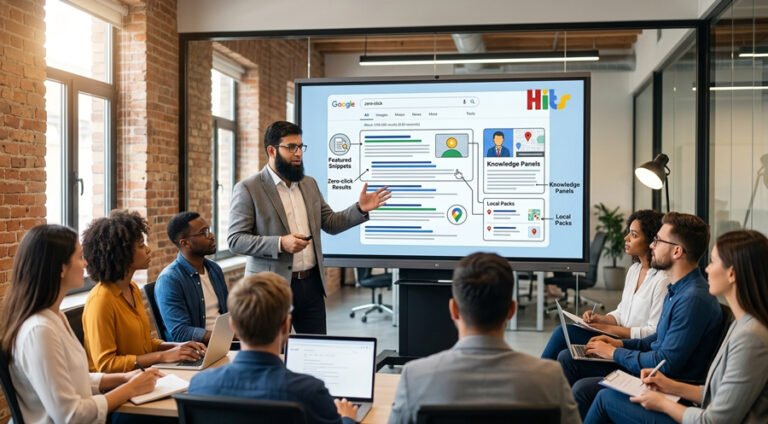
- AEO (Answer Engine Optimization): This is the evolution of the “Featured Snippet.” AEO focuses on providing a direct, high-certainty answer to a specific question. When a user asks Siri, “How do I fix a leaky pipe?” or sees a “People Also Ask” box on Google, that is AEO at work. The goal is to be the instant answer.
- GEO (Generative Engine Optimization): This is the strategy for the “Chat” era. GEO is about ensuring your content is the source of truth that an LLM (like ChatGPT, Gemini, or Perplexity) uses to build its response. When an AI synthesizes a narrative about “The Best Web Design Agencies in Pakistan,” GEO ensures HITS Web SEO Write is cited as a trusted authority.
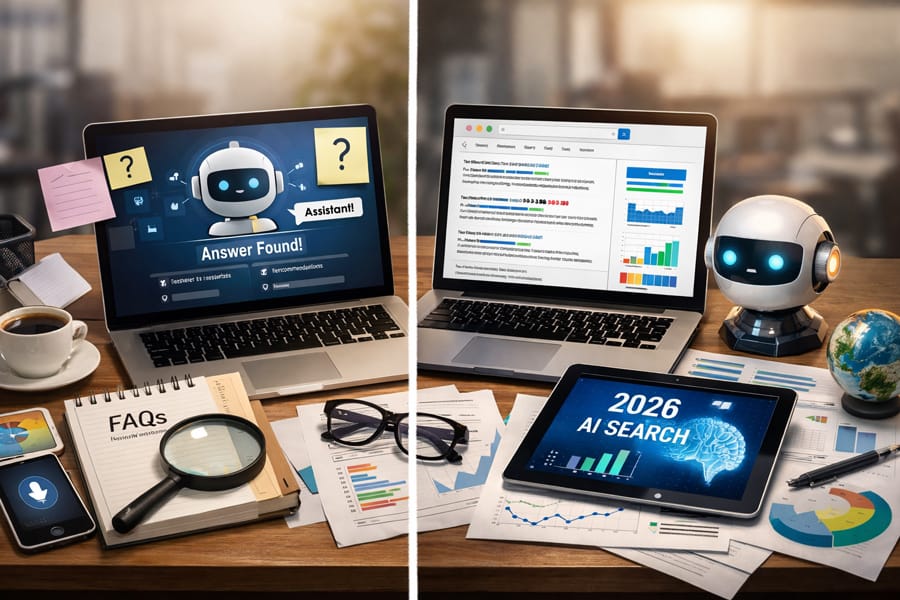
AEO vs. GEO Comparison Matrix
| Feature | AEO (Answer Engine Optimization) | GEO (Generative Engine Optimization) |
| Primary Goal | Direct answer surfacing (Snippets). | Citation and summary inclusion (LLMs). |
| User Intent | Fact-seeking or “How-to” (High intent). | Research and comparison (Broad intent). |
| Winning Metric | Position Zero visibility. | Sentiment & Citation Count. |
| Format | Concise, objective, FAQ-style. | Contextual, data-dense, authoritative. |
| Key Player | Google PAA, Alexa, Siri. | ChatGPT, Perplexity, Google AI Overviews. |
📈 2. Which Content Types Perform Best?
To win in 2026, you cannot use a one-size-fits-all approach. You must map your content to the specific engine you are targeting.
For AEO: The “Snippet-Ready” Content
- Definitions: “What is [Industry Term]?” followed by a 40-60 word definition.
- Step-by-Step Guides: Numbered lists for processes.
- Pricing & Comparisons: Direct tables comparing costs or features.
- FAQs: Using schema markup to signal “Question” and “Answer” pairs.
For GEO: The “Knowledge-Base” Content
- Original Research: Proprietary data that AI cannot “hallucinate” or find elsewhere.
- Expert Opinions: First-hand experience (E-E-A-T) that adds “Information Gain.”
- Case Studies: Detailed narratives that show real-world application.
- Thought Leadership: Deep-dive whitepapers that define a niche.
🏗️ 3. Structuring Pages for Machine Consumption
Search engines and AI models no longer “read” your site; they “ingest” it. To maximize your LLM-First Crawling Budget, follow these structural rules:
- The Answer-First Header (H2): Start every major section with a question-based heading, followed immediately by a bolded, one-sentence answer.
- Semantic Chunking: Break long topics into self-contained “chunks.” If an AI “lifts” a paragraph to use as a citation, it should contain enough context to stand alone.
- Entity Linking: Use JSON-LD Schema to link your brand to established entities. Don’t just say “We are in Lahore”; use schema to point to the official Wikidata entry for Lahore.
- Information Gain (IG): AI models favor content that provides new information. We can visualize the value of a page as: IG = Unique Data Points – Commonly Indexed Facts
⚠️ 4. Common Mistakes Holding Businesses Back
- Mistake #1: Marketing Fluff. AI crawlers are “token-sensitive.” If your page is 80% adjectives (“We are the most amazing, spectacular team”) and 20% facts, the AI will ignore you for a more concise competitor.
- Mistake #2: Treating AI as a Tool, Not a Channel. Many marketers use AI to write content, but don’t optimize content for AI.
- Mistake #3: Ignoring Freshness. Generative engines prioritize current data. If your pricing or service list hasn’t been updated in 6 months, an AI agent may label your business as “outdated” or “inactive.”
❓ FAQ About The AEO & GEO
Q1: Can I rank in AEO and GEO on the same page?
Yes, but you must structure the page with “Layers.” Use a concise AEO-style summary at the top (for snippets) and deep-dive, GEO-style analysis below (for LLM synthesis).
Q2: Does GEO mean I will get less traffic to my website?
Potentially, yes. AI Overviews often provide the answer without a click. However, the traffic you do get will be much higher intent, as the user has already been “pre-sold” by the AI’s recommendation.
Q3: Is schema markup still relevant in 2026?
It is more relevant than ever. Schema acts as the “translation layer” between your messy HTML and the AI’s clean database.
Q4: How does E-E-A-T affect GEO?
AI models use your “Digital Reputation” (mentions on other sites, reviews, and author credentials) to decide if you are a “Source of Truth.” Without high E-E-A-T, you won’t be cited.
Q5: What is the biggest difference between voice search and ChatGPT search?
Voice search (AEO) usually gives one single answer. ChatGPT search (GEO) summarizes multiple sources, meaning you don’t have to be #1, but you must be in the top 5 cited sources.
🚀 Future-Proof Your Business with HITS Web SEO Write
The shift from traditional SEO to AISO (AI Search Optimization) is the biggest change in the history of the internet. In Pakistan, HITS Web SEO Write is at the forefront of this revolution.
We don’t just “do SEO.” We build AI-Ready Digital Entities. Our services are designed specifically for the 2026 search economy:
- Web Design: We build “Technical Purity” into every site, ensuring instant crawlability for LLMs.
- AEO & GEO Strategy: We optimize your content to win both the direct answer snippets and the authoritative AI citations.
- Content Writing: Our writers are trained in “Information Gain” techniques, producing research-backed copy that AI agents love to quote.
Is your website an “Answer” or an “Afterthought”?
Would you like us to provide a Strategic AI Visibility Audit for your business to see where you stand in the eyes of ChatGPT and Google AI?