
Table of Contents
Surviving Zero-Click Search: A Comparative Guide to Content Strategies That Still Win
Most Google searches no longer send a visitor to your website. Studies from SparkToro, Similarweb, and Bain & Company all point the same way: somewhere between 6 and 8 out of every 10 searches now end right on the results page. AI Overviews, featured snippets, and knowledge panels answer the question before anyone clicks a link.
This does not mean your website is dead. It means the goal has changed. You are no longer just fighting for clicks. You are fighting to be the answer Google shows, quotes, or names. Small business owners, local retailers, and blog managers who adapt their content now will keep getting found. Those who don’t will slowly disappear from view, even if their rankings look fine on paper.
This guide compares the old click-based approach to the new answer-based approach, shows what actually works, and gives you a plan you can start today.
What Is Zero-Click Search, Really?
A zero-click search happens when a person types a question into Google and gets the answer without leaving the page. No click. No visit. No page view in your analytics.
Ask Google “what time zone is Karachi in” and you get the answer instantly. Ask “how to remove a stripped screw” and an AI Overview may summarize the steps right there. The searcher walks away happy. Your website never entered the picture, even if your content was the source Google pulled from.
This matters most for informational search intent, questions, how-tos, definitions, comparisons. People searching “best time to water plants in summer” or “how much does a logo design cost” usually want a quick answer, not a ten-page article. Google knows this, and it builds its results pages to match.
Transactional searches (“buy running shoes near me”) and navigational searches (“Facebook login”) still send clicks. But the informational searches that fill most blogs and FAQ pages? Those are the ones getting swallowed by zero-click content.
Why Google’s Search Results Changed So Much
Google didn’t do this overnight, but the pace picked up fast in the last two years. A few forces pushed it here:
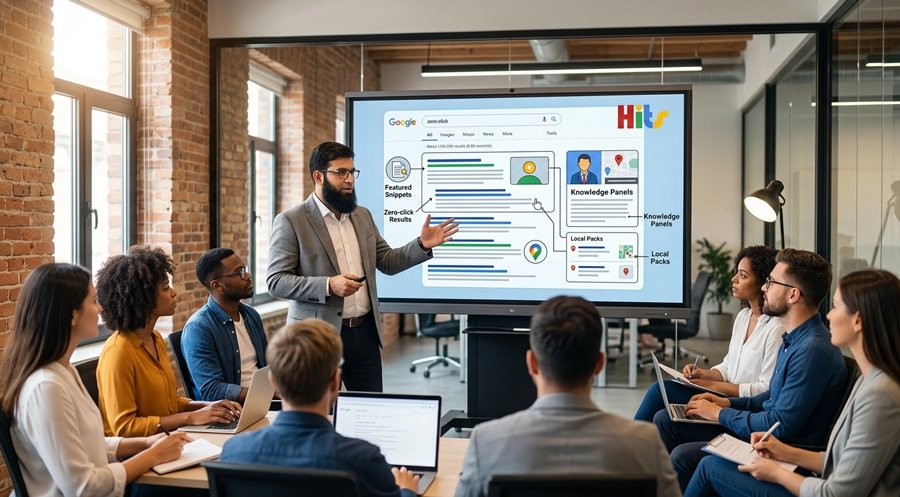
- AI Overviews. Google now uses generative AI to summarize answers at the top of many searches, pulling from several sources at once.
- Featured snippets. The boxed answer above the normal results, often called “position zero,” has existed for years and still eats clicks.
- Knowledge panels. Boxes on the right side of the page that show facts about a business, person, or topic.
- Local packs. The map and three-listing box that answers “near me” searches instantly.
- Voice search and assistants. Devices like phones and smart speakers read out one answer, not ten blue links.
Data collected in 2026 shows zero-click rates on mobile searches are now higher than on desktop, and searches that trigger an AI Overview see click-through rates drop sharply compared to plain search results. When a brand does get named or cited inside an AI Overview, though, it tends to earn more clicks than an uncited competitor on the same search. Being the answer still matters. Being ranked tenth on a page nobody scrolls to does not.
Old SEO vs. Zero-Click Optimization: A Side-by-Side Comparison
The playbook that worked in 2018 needs an update. Here’s how the two approaches differ.
| Factor | Old-School SEO | Zero-Click Content Optimization |
|---|---|---|
| Main goal | Rank #1, earn the click | Become the quoted answer, earn the trust |
| Content length | Longer usually wins | Short, direct answers near the top, detail below |
| Success metric | Organic traffic, click-through rate | Impressions, brand mentions, snippet wins, conversions from fewer but higher-intent visitors |
| Keyword focus | Exact match keywords | Questions, conversational phrases, search intent |
| Structure | Wall-of-text articles | Scannable answers, bullet lists, tables, defined terms |
| Local visibility | Website ranking alone | Google Business Profile, reviews, local structured data |
| Authority signal | Backlinks mostly | Backlinks plus clear author identity and real expertise (E-E-A-T) |
| Where the “win” shows up | Search results page ranking | Featured snippet, AI Overview citation, knowledge panel, local pack |
Neither approach replaces the other completely. Good zero-click content still needs solid technical SEO underneath it. But the target has shifted from “rank high” to “get chosen as the answer.”
Content Strategies That Actually Work in the Zero-Click Era
1. Answer the Question in the First Two Sentences
Google’s snippet and AI Overview systems pull short, direct answers. If your article buries the answer under three paragraphs of introduction, you lose.
Put the direct answer right after the heading. Then explain the details below it for readers who want more.
Example structure:
- H2: How long does a logo design take?
- First line: Most logo designs take 5 to 10 business days from brief to final files.
- Next paragraph: factors that speed it up or slow it down.
This format serves two readers at once: the person who wants a fast answer, and the person who wants the full picture.
2. Write for Questions, Not Just Keywords
People don’t type keywords anymore. They ask full questions, especially on voice search. “Best bakery near me open now” beats “bakery Lahore” as a real-world query.
Build content around question-based headings:
- What is…
- How does…
- Why do…
- How much does…
- Is it safe to…
Tools like Google’s “People Also Ask” box, AnswerThePublic, and even your own customer emails are goldmines for these real questions.
3. Use Structured Data (Schema Markup)
Schema markup is code that tells Google exactly what your content means. It’s the difference between Google guessing and Google knowing.
Priority schema types for small businesses:
- LocalBusiness schema: address, hours, phone number
- FAQ schema: question-and-answer pairs
- Product schema: price, availability, reviews
- Article schema: author, publish date, headline
Adding this code doesn’t guarantee a featured snippet or AI citation, but it removes guesswork for Google and makes your content easier to select.
4. Build a Real FAQ Section on Every Key Page
FAQ sections do double duty. They answer real customer questions, and they give Google short, clean text blocks to pull for snippets and AI summaries.
Keep each answer under 50 words when possible. Longer explanations can follow, but the first sentence should stand alone as a complete answer.
5. Strengthen Your Local Search Presence
For local retailers, the local pack and Google Business Profile matter more than blog rankings ever will. Someone searching “hardware store near me” rarely scrolls past the map.
Steps that move the needle:
- Keep your Google Business Profile fully filled out and updated
- Collect and respond to reviews regularly
- Add real photos, not stock images
- List accurate hours, especially holiday hours
- Use location-specific pages if you serve multiple areas
A well-run Business Profile can outperform an entire website for local, zero-click visibility.
6. Build Topical Authority, Not Just Single Articles
Google and AI systems favor sites that show depth on a subject, not just one lucky post. A blog manager publishing one great article on “email marketing tips” competes against sites with fifty related articles covering every angle.
Build content clusters: one main pillar page, several supporting articles, all linked together. This signals expertise and gives Google more chances to cite you across related questions.
7. Earn Mentions, Not Just Backlinks
AI Overviews often pull from multiple sources, sometimes without a clickable link at all. Being mentioned by name, even without a direct backlink, still builds brand recognition among people scanning results.
Ways to earn mentions:
- Get quoted in local news or industry roundups
- Contribute guest posts to trusted sites in your niche
- Answer questions on forums and Q&A platforms with your business name attached
- Partner with other local businesses for co-marketing content
8. Track the Right Metrics
Traffic alone no longer tells the full story. If your click-through rate drops but your impressions and brand searches rise, that can still be a win. It means people are seeing you, even without clicking.
Metrics worth watching in 2026:
- Search impressions (Google Search Console)
- Featured snippet ownership
- Branded search volume (are more people searching your business name directly?)
- Conversion rate of the traffic you do get
- Local pack appearances
AI Overviews vs. Featured Snippets: What’s the Difference?
Business owners often mix these two up. They look similar on the page, but they work in different ways, and each needs a slightly different content approach.
Featured snippets pull one exact block of text, a list, or a table from a single web page. Google chooses one source and shows it at the top of the results, above the normal ten blue links.
AI Overviews are different. They generate a new summary using several sources at once, blending information instead of quoting one page directly. Sometimes your content shapes the answer without any visible credit at all. Other times, Google adds a small citation link next to your brand name.
Here’s how they compare:
| Feature | Featured Snippet | AI Overview |
|---|---|---|
| Source count | One page | Multiple pages blended together |
| Format | Direct quote, list, or table | AI-written summary |
| Visibility for you | Clear box with your page linked | May or may not show a visible citation |
| Best content type | Clean, single-answer blocks | Well-structured, fact-based, authoritative pages |
| How to target it | Answer one question precisely | Build broad topical depth and clear facts |
The practical takeaway: keep writing tight, single-answer blocks for snippets, but also build out broader, fact-dense pages so AI systems have solid material to pull from when they write a summary. Both formats reward clarity. Neither rewards vague, filler-heavy writing.
Why E-E-A-T Still Matters in a Zero-Click World
Google uses a framework called E-E-A-T: Experience, Expertise, Authoritativeness, and Trustworthiness. It’s not a ranking factor you can add with a plugin. It’s a set of signals Google’s systems, human quality raters, and AI summarizers all check before trusting a page enough to quote it.
For small businesses, this looks practical, not abstract:
- Experience: Show real photos of your shop, your team, or your finished work. A roofing company that posts before-and-after job photos signals real experience better than stock images ever will.
- Expertise: Have content written or reviewed by someone who actually knows the subject. A dentist’s blog post about tooth pain should carry a dentist’s name, not “Admin.”
- Authoritativeness: Get mentioned by other trusted sites in your industry or city. A local chamber of commerce link or an industry association mention carries real weight.
- Trustworthiness: Keep contact information visible, use secure checkout if you sell online, and correct outdated information quickly.
None of this guarantees a snippet or an AI citation. But content lacking these signals rarely earns one, no matter how well it’s formatted.
Tools That Help You Track Zero-Click Performance
You don’t need an expensive software stack to monitor this shift. A handful of free and low-cost tools cover most of what a small business or blog manager needs:
- Google Search Console: shows impressions, click-through rate, and which queries trigger your pages, even when clicks stay flat
- Google Business Profile Insights: tracks how people find your local listing and what actions they take
- AnswerThePublic or AlsoAsked: surfaces real question phrasing people search for
- Schema markup testing tools: confirm your structured data is error-free before Google crawls it
Checking Search Console monthly, rather than daily, is usually enough for a small team. Watch the trend line, not the daily noise.
Comparing Content Formats for Zero-Click Visibility
Different content formats win different types of zero-click real estate. Here’s a quick comparison to help you choose where to focus.
| Content Format | Best For | Zero-Click Opportunity |
|---|---|---|
| Short FAQ blocks | Quick factual questions | Featured snippets, AI Overviews |
| How-to guides with numbered steps | Process questions | Featured snippets (list format), voice search |
| Comparison tables | “X vs Y” searches | Featured snippets (table format) |
| Local landing pages | “Near me” searches | Local pack, map results |
| Long-form pillar articles | Broad topic authority | AI Overview citations, backlinks |
| Video with transcripts | Visual how-to content | Video carousels, snippet text pulled from transcript |
Small business owners with limited time should prioritize FAQ blocks and local landing pages first. They take less effort and target searches with the clearest local intent.
Common Mistakes That Hurt Zero-Click Visibility
Even well-meaning content teams fall into these traps:
- Stuffing keywords instead of answering questions. Google’s systems reward clear answers, not repeated phrases.
- Ignoring page speed. Slow pages struggle to earn snippets, since Google favors fast, reliable sources.
- Skipping schema markup. Without it, Google has to guess your content’s structure.
- Writing answers that are too vague. “It depends” is not a snippet-worthy answer. Give a real number, step, or fact first, then explain nuance after.
- Forgetting mobile formatting. Most zero-click searches happen on phones. Long paragraphs without breaks lose readers fast.
- Neglecting the Google Business Profile. Many local retailers spend all their budget on the website and none on their free local listing.
A Simple Action Plan by Audience
Small business owners:
- Fill out your Google Business Profile completely
- Add an FAQ section to your homepage and service pages
- Collect five new reviews this month
Local retailers:
- Create a location page for each store
- Add LocalBusiness schema to every location page
- Keep hours and holiday closures updated at all times
Blog managers:
- Rewrite your top ten posts to answer the main question in the first two sentences
- Add FAQ schema to your highest-traffic articles
- Build one topic cluster around your most valuable keyword this quarter
SEARCH IS CHANGING
Surviving Zero-Click Search
60-80%
searches end with no click
83%
zero-click rate when AI Overview appears
35%
more clicks for brands cited in AI answers
Old SEO vs. Zero-Click Optimization
Old-School SEO
- Chase the click
- Long intros before the answer
- Exact-match keywords
- Traffic is the only metric
Zero-Click Optimization
- Become the quoted answer
- Answer in the first 2 lines
- Real questions, real intent
- Impressions & citations count too
4 Strategies That Work Now
Answer First
Give the direct answer in the first two sentences.
Add FAQ Schema
Short Q&A blocks Google can pull instantly.
Win Local Search
Keep your Google Business Profile complete and active.
Build Topical Depth
Cluster content so Google trusts you as the expert.
Frequently Asked Questions
What is a zero-click search?
A zero-click search is any Google search where the person finds their answer on the results page itself and never clicks through to a website.
Are zero-click searches bad for my business?
Not always. They reduce direct clicks, but being named or cited as the answer builds brand trust and recognition, even without a visit.
How do I optimize for featured snippets?
Answer the target question clearly in the first sentence or two, use lists and tables where they fit, and keep your formatting clean and scannable.
Does schema markup guarantee a featured snippet?
No. It improves your chances by making your content easier for Google to understand, but it does not guarantee placement.
Should I stop writing long articles?
No. Long articles still build topical authority. Just make sure the direct answer appears early, with supporting detail afterward.
How can a small business measure success if traffic drops?
Track impressions, branded search volume, local pack appearances, and conversion rates. A drop in raw traffic paired with steady or rising leads can still mean progress.
Final Word
Zero-click search is not a passing trend. It’s the new normal for how people find information. Businesses that keep writing for 2018-style rankings will keep losing visibility, even while their content stays technically “optimized.”
The businesses that adapt, by answering questions clearly, strengthening local listings, and building real topical authority, will keep showing up where it counts: right at the top of the answer, whether or not anyone clicks.
Ready to make your content resilient against these SERP changes? The team at webseowrite.pk builds content strategies designed for exactly this shift, from FAQ-rich blog content to local search optimization. If you want a content plan built for the zero-click era, webseowrite.pk can help you enhance your brand’s search resilience. Explore the full range of services at webseowrite.pk/services.