

Table of Contents
The Death of Keyword Stuffing: Why Entity-First SEO Now Rules Search
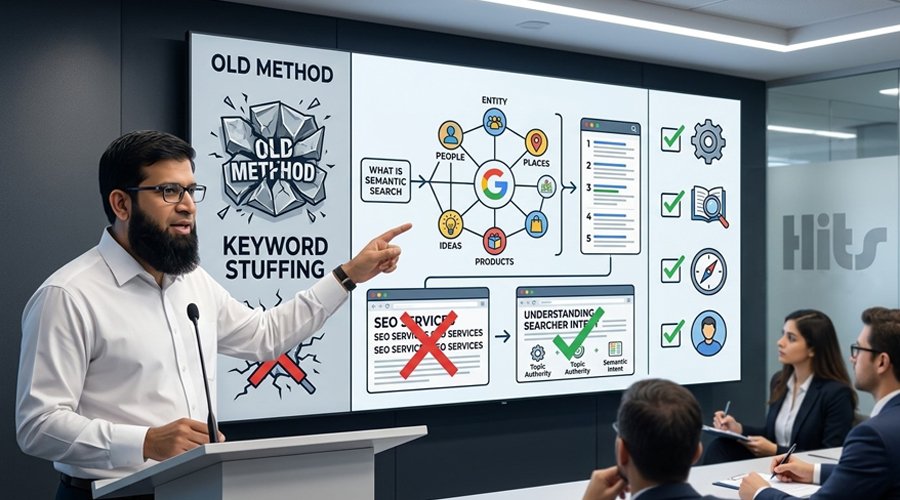
Keyword stuffing is dead. Google no longer counts how many times a word appears on your page. It now asks a different question: does this page understand the topic? This shift is called entity-first SEO. It means writing about real things, people, places, products, ideas, the way Google’s Knowledge Graph understands them. Instead of repeating “best running shoes” fifty times, you write about running shoes as a real product category, connected to brands, materials, foot types, and use cases.
If you still write content around keyword density, you are optimizing for a search engine that stopped existing years ago. This article explains what changed, why it changed, and how content writers can adapt. It also shows a side-by-side comparison of old-school keyword tactics versus entity-first writing, so you can see the difference in practice.
What Was Keyword Stuffing, and Why Did It Work Once?
In early search engines, ranking was simple math. A page that used “cheap flights to Dubai” ten times ranked higher than a page that used it twice. Search engines matched text strings, not meaning.
This led to bad habits:
- Repeating the same phrase over and over, even when it sounded unnatural.
- Hiding keywords in white text on white backgrounds.
- Stuffing keywords into alt tags, footers, and meta tags with no real content behind them.
- Writing for algorithms first, humans second.
This worked because the algorithm was counting words, not understanding them. But this approach broke down as search engines got smarter.
The Turning Point: Google Knowledge Graph
In 2012, Google launched the Knowledge Graph. This was a database of real-world entities, people, places, organizations, events, and things, along with how they connect.
Instead of matching text strings, Google started matching meaning. Search “Apple” and Google now knows whether you mean the fruit or the company, based on context, other words in your search, and your past behavior.
This changed everything about how content gets ranked. A page no longer earns rank by repeating a phrase. It earns rank by proving it understands the entity being discussed and how that entity connects to other entities.
A Simple Example
Say you write about “Lahore.” A keyword-stuffed page repeats “Lahore” nonstop. An entity-first page connects Lahore to what it actually is:
- A city in Punjab, Pakistan
- Home to landmarks like the Badshahi Mosque
- Connected to historical events, cultural festivals, and food traditions
- Linked to nearby cities and provinces
Google’s Knowledge Graph already holds this data. When your content matches these real connections, Google trusts that your page genuinely understands Lahore, not just that it mentions the word.
Semantic Search Networks: How Google Reads Meaning
Semantic search networks are the systems Google uses to understand relationships between words, topics, and entities. They look at context, not just keywords.
Here’s how this plays out in practice:
- Synonym recognition: Google knows “sneakers,” “trainers,” and “running shoes” often mean the same thing.
- Context clues: the word “bank” means something different next to “river” than next to “loan.”
- Topic clusters: pages that cover a subject fully, with related subtopics, rank better than pages that cover one narrow phrase.
- User intent matching: Google tries to guess why someone searched, not just what words they typed.
This is powered by natural language processing, commonly called NLP content writing when applied to how we write for search. NLP lets Google’s systems read a paragraph almost the way a person would, spotting topics, tone, and relationships between ideas.
Keyword Density vs Authority: The Real Comparison
This is the heart of the shift. Old SEO measured keyword density, the percentage of a page made up of a target phrase. New SEO measures authority, how completely and accurately a page covers a topic.
| Factor | Keyword Density Approach | Entity-First Authority Approach |
|---|---|---|
| Main goal | Repeat exact phrase often | Cover topic fully and accurately |
| Writing style | Forced, repetitive | Natural, varied language |
| Ranking signal | Word count of target phrase | Topic coverage, related entities, trust signals |
| Content depth | Thin, phrase-focused | Deep, includes related subtopics |
| Reader experience | Often awkward to read | Reads naturally, answers real questions |
| Link value | External links used mainly for keywords | Links to authoritative sources build trust |
| Long-term result | Penalized by Google updates | Rewarded by Google updates |
Why Authority Wins Now
Google wants to show searchers the best possible answer, not just the page with the most repeated words. Authority is built by:
- Covering a topic from multiple angles.
- Mentioning related entities Google already recognizes.
- Using clear, accurate facts.
- Linking to and being linked from trusted sources.
- Showing real expertise, not just repeated phrases.
A page that mentions “diabetes,” “insulin,” “blood sugar,” and “type 2 diabetes” naturally within one well-organized article signals real topic knowledge. A page that repeats “diabetes treatment” thirty times signals nothing but spam.
How NLP Content Writing Changes Your Process
Writing for NLP content writing means shifting your process before you even open a document.
Step 1: Research Entities, Not Just Keywords
Instead of starting with a keyword tool, start by asking: what entities matter here? If you’re writing about electric cars, related entities include battery technology, charging networks, specific car brands, government incentives, and environmental impact.
Step 2: Build Topic Clusters
Group related subtopics under one main topic. A single article on “electric cars” might branch into charging times, cost comparisons, and maintenance differences. Each subtopic supports the main entity.
Step 3: Write Naturally, Not Repetitively
Use synonyms and related terms. Instead of repeating “electric car” nonstop, mix in “EV,” “battery-powered vehicle,” and specific brand names. This matches how real people write and speak.
Step 4: Add Structured Data
Schema markup helps Google confirm what your entities are. Marking up a recipe, a product, or a person with structured data tells Google exactly what it’s looking at, reducing guesswork.
Step 5: Link to Trusted Entities
Linking out to authoritative sources, government sites, established news outlets, and academic sources helps Google confirm your content sits within a trusted network of information.
Real-World Example: Two Articles Compared
Imagine two articles both targeting “best coffee beans for espresso.”
Article A (Keyword Density Style): Repeats “best coffee beans for espresso” fifteen times in 800 words. Talks in circles. Offers no brand comparisons, no roast details, no brewing science.
Article B (Entity-First Style): Discusses Arabica versus Robusta beans, roast levels, grind size, specific well-known brands, and how altitude affects flavor. Mentions “espresso machines,” “crema,” and “extraction time,” all entities connected to espresso in Google’s Knowledge Graph. Uses the target phrase naturally, just three or four times.
Article B wins. It answers more questions, connects more real entities, and reads like it was written by someone who actually knows coffee.
Common Mistakes Writers Still Make
Even experienced writers fall into old habits. Watch for these:
- Over-optimizing for one exact phrase instead of the broader topic.
- Ignoring related entities that would prove topic depth.
- Writing thin content that repeats one idea instead of expanding it.
- Skipping structured data, leaving Google to guess what the page is about.
- Copying competitor phrasing instead of adding original insight.
Why This Matters for Content Writers and Marketers
If you’re a content writer or a traditional digital marketer, this shift affects your daily work directly. Clients may still ask for keyword-stuffed content because that’s what they learned years ago. Part of your job now is educating them.
Show them the data. Pages built around topic authority tend to hold rankings longer and survive algorithm updates better than pages built around repeated phrases. Google’s updates over the past decade have consistently rewarded depth and punished repetition.
This is also an opportunity. Writers who understand entity-first SEO can charge more, deliver better results, and build long-term client trust, instead of chasing short-term ranking tricks that eventually get penalized.
How to Start Writing Entity-First Content Today
You don’t need a huge budget or fancy tools to start. Follow this simple checklist:
- Pick your main topic and list every related entity you can think of.
- Search that topic on Google and note the “People also ask” and related searches; these reveal connected entities.
- Outline your article around subtopics, not just one repeated phrase.
- Write naturally, using synonyms and varied phrasing.
- Add facts, examples, and comparisons that prove real knowledge.
- Link to trusted external sources where relevant.
- Use structured data where it fits, like FAQ or product schema.
- Read your draft out loud; if it sounds robotic or repetitive, rewrite it.
This process takes more thought than old-school keyword stuffing, but it produces content that actually ranks and actually helps readers.
Where This Is Heading
Search is moving even further toward understanding meaning, not matching words. Voice search, AI-generated answers, and conversational search all depend on entities and context, not exact keyword matches. Writers who master entity-first thinking now will be ready for whatever comes next in search.
This is exactly the kind of content strategy that platforms like webseowrite.pk are built around, treating each page as a network of connected ideas, not a container for repeated phrases. Teams that understand this shift produce content that performs, instead of content that gets buried in later Google updates.
Keyword Stuffing Is Dead
Repeating a phrase no longer boosts rank. Google ignores forced repetition.
Knowledge Graph
Google maps real entities – people, places, things – and how they connect.
Semantic Search
NLP reads meaning and context, not just matching exact words.
Authority Wins
Full topic coverage beats keyword density, every single time.
Keyword Density vs Authority
- Repeats one exact phrase
- Reads forced, unnatural
- Thin, narrow content
- Penalized by updates
- Covers the full topic
- Reads natural and varied
- Deep, related subtopics
- Rewarded by updates
Get Content That’s Actually Built for Semantic Search
Keyword stuffing had its moment. That moment is over. Entity-first SEO is how modern search actually works, and it’s not going anywhere.
If your content still leans on old-school keyword density, it’s time for a rewrite. webseowrite.pk specializes in premium content built around semantic search guidelines, real topic depth, proper entity coverage, and writing that reads naturally to both people and search engines.
👉 Get premium, semantic-search-ready content from webseowrite.pk
FAQs
Q: Is keyword research still useful at all?
Yes. Keywords still tell you what people search for. The difference is you now use keywords as a starting point for topic research, not as the final goal for repetition.
Q: How many times should I use my main keyword now?
There’s no magic number. Use it where it fits naturally, usually a few times across a long article, along with synonyms and related terms.
Q: What exactly is an “entity” in SEO terms?
An entity is any real, distinct thing- a person, place, product, brand, or concept- that Google can identify and connect to other entities in its Knowledge Graph.
Q: Does entity-first SEO mean I should ignore keywords completely?
No. Keywords still matter for matching search intent. Entity-first SEO just adds depth around those keywords instead of relying on repetition alone.
Q: How long does it take to see results from entity-first content?
Results vary, but entity-rich, authoritative content tends to build rankings steadily and hold them longer than keyword-stuffed pages, which often drop after algorithm updates.
Q: Can small businesses compete with entity-first SEO against bigger brands?
Yes. Depth of knowledge matters more than size. A small business that writes genuinely detailed, accurate content about its niche can outrank larger sites with thin content.