
Table of Contents
Formatting Local Business Data for Voice and Conversational Engines
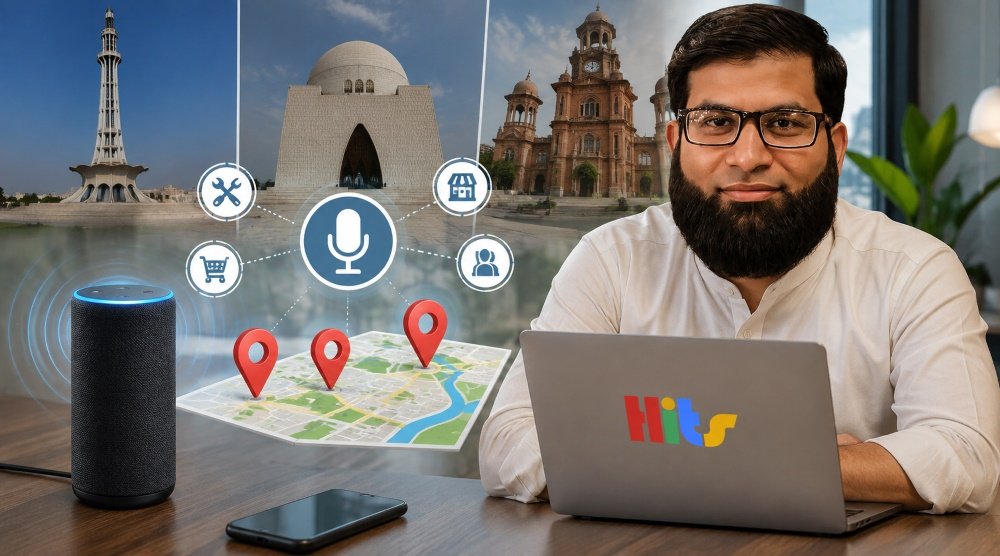
Voice search is changing how people in Lahore, Karachi, and Sialkot find local businesses. People no longer type “plumber near me.” They ask their phone, “Who can fix my sink right now?”
If your business data is not formatted for this shift, you lose the customer before they even see your name. This guide shows local service providers how to format their business data for voice search and conversational search engines. It compares old-style local SEO with voice-ready local SEO, gives clear steps, and shows real examples for Pakistani cities.
The short answer: structure your data, write as people talk, and use local schema markup. That is how you win hands-free search in 2026.
Why Voice Search Matters for Local Businesses in Pakistan
Smartphone use in Pakistan keeps growing every year. More people use voice assistants on their phones because typing in Urdu or English while driving or working is hard. A shopkeeper in Anarkali or a mechanic in Gulshan-e-Iqbal now competes for attention with voice-based answers, not just blue links on a screen.
Voice search local SEO is different from normal SEO in three ways:
- Longer queries. People speak in full sentences, not short keywords.
- Question-based searches. Most voice searches start with who, what, where, or how.
- One answer wins. Voice assistants usually read out one result, not ten.
This means local service providers need conversational local queries built into their content. If your website only has short keyword phrases like “AC repair Lahore,” you may miss out. Voice assistants prefer content that sounds like a real answer to a real question.
Old-Style Local SEO vs Voice-Ready Local SEO
Here is a simple comparison table to show the difference.
| Factor | Old-Style Local SEO | Voice-Ready Local SEO |
|---|---|---|
| Keyword style | Short phrases (“electrician Karachi”) | Full questions (“Who is the best electrician near me in Karachi?”) |
| Content tone | Formal, keyword-stuffed | Natural, conversational |
| Business listing | Basic name, address, phone | Full schema markup with hours, reviews, services |
| Search device | Mostly desktop and typing | Mostly mobile and speaking |
| Answer format | List of links | Single spoken answer or featured snippet |
| Local focus | City-level only | Neighborhood-level detail |
This table shows why regional optimization matters more today. A plumber in Sialkot cannot just say “plumber in Punjab.” They need to target specific areas like Kashmir Road or Cantt.
How Voice Assistants Pick Local Answers
Voice assistants like Google Assistant and Siri pull answers from structured data. They do not read your whole website. They scan for clear, direct facts.
To get picked, your business data needs three things:
- Accurate NAP data: Name, Address, Phone number, matching everywhere online.
- Clear service descriptions: written in plain language, not jargon.
- Local schema optimization: code that tells search engines exactly what your business does and where.
Without these three, even a great business can stay invisible in voice results.
Local Schema Optimization: The Technical Backbone
Schema markup is a code layer added to your website. It tells Google and voice assistants exactly what your business is, where it is, and what it offers. Think of it as a label on a box. Without the label, the delivery person has to guess what’s inside.
Key Schema Types for Local Service Providers
- LocalBusiness Schema: basic details like name, address, and hours.
- Service Schema: lists specific services you offer, like “geyser repair” or “car detailing.”
- Review Schema: shows star ratings directly in search results.
- FAQ Schema: answers common questions right on the search page.
Example of Local Schema Markup (Simplified)
A tailor shop in Sialkot might use schema markup like this:
Business Name: Al-Noor Tailors
Address: Kashmir Road, Sialkot
Phone: 0300-XXXXXXX
Hours: 9 AM - 9 PM, Monday to Saturday
Services: Custom suits, alterations, uniform stitching
When this data is properly coded, a voice search like “Is there a tailor open near me right now?” can pull this shop’s hours and location directly into the spoken answer.
Writing Content for Conversational Local Queries
People do not talk to Alexa or Google Assistant the way they type into a search bar. They ask full questions. Your website content should match that pattern.
Instead of This:
“Best AC repair Lahore cheap rates”
Write This:
“Looking for affordable AC repair in Lahore? Our team fixes cooling issues the same day, at fair prices.”
This small shift makes a big difference. Search engines match natural sentences to natural questions.
Steps to Write Voice-Friendly Content
- List the top 10 questions your customers ask.
- Write short, direct answers for each one.
- Use everyday words, not technical terms.
- Add your city and neighborhood names naturally.
- Keep answers under 30 words when possible, since voice assistants often read short answers first.
Regional Optimization: Lahore, Karachi, and Sialkot
Each city has its own search behavior. A one-size-fits-all approach does not work well for regional optimization.
Lahore
Lahore has heavy competition in service categories like home repair, beauty salons, and food delivery. Local providers should focus on neighborhood names such as DHA, Model Town, or Johar Town, since voice searches often include area names.
Karachi
Karachi is huge and spread out. People search by area because distance matters more here than in smaller cities. A mechanic in Korangi will not get calls from someone in Clifton searching by voice. Precise area tagging in your business listing is critical.
Sialkot
Sialkot has a strong local business community, especially in leather goods, sports equipment, and surgical instruments. Voice search here often includes trade-specific terms. A supplier should include both English and common local phrasing customers might speak.
Quick Reference Table for Regional Keywords
| City | Sample Voice Query | Suggested Content Focus |
|---|---|---|
| Lahore | “Find a bridal makeup artist near DHA” | Neighborhood-specific service pages |
| Karachi | “Which car workshop is open now in Korangi?” | Area-based hours and location details |
| Sialkot | “Best sports goods supplier near Kashmir Road” | Trade-specific service descriptions |
Google Business Profile: Your Voice Search Foundation
Before writing any content, fix your Google Business Profile. Voice assistants pull directly from this source.
Checklist for a strong profile:
- Use your real business name, no keyword stuffing.
- Add a complete address with area name.
- List an accurate phone number and website.
- Update business hours, including holidays.
- Add photos of your shop, staff, or work samples.
- Respond to every review, good or bad.
- Add a short, clear business description in plain language.
A shopkeeper in Sialkot who updates hours during Eid will show up correctly when a customer asks, “Is this shop open today?” One who forgets this step may get skipped entirely.
Common Mistakes Local Businesses Make
Many local service providers lose voice search visibility due to simple errors.
- Inconsistent NAP data across Facebook, Google, and their website.
- Missing schema markup on their website.
- Keyword-stuffed content that sounds robotic.
- No FAQ section answering common customer questions.
- Ignoring mobile speed, voice search results almost always come from mobile-friendly sites.
Fixing even two or three of these issues can improve visibility fast.
Building an FAQ Section That Works for Voice Search
FAQ sections are gold for conversational local queries. Voice assistants love pulling short, clear answers from FAQ pages.
Example FAQ for a Local Electrician in Lahore
Q: How fast can an electrician reach my house in Lahore? A: Most electricians in Lahore can reach your location within 30 to 60 minutes, depending on traffic and area.
Q: Do electricians in Lahore work on Sundays? A: Many local electricians offer Sunday service, but it’s best to confirm ahead of time.
This format matches how people actually speak to voice assistants, which improves your chances of being read out loud as the answer.
Step-by-Step Plan to Get Voice-Search Ready
Here is a simple action plan for any local service provider in Pakistan.
- Audit your current listings. Check Google Business Profile, Facebook, and directories for matching NAP data.
- Add schema markup. Use LocalBusiness and Service schema on your website.
- Rewrite key pages. Turn keyword phrases into natural questions and answers.
- Add an FAQ section. Answer at least 8 to 10 real customer questions.
- Localize by neighborhood. Mention specific areas, not just the city name.
- Monitor voice search performance. Track which questions bring in calls or visits.
- Update regularly. Hours, services, and offers change; keep data fresh.
This process is not a one-time task. Voice search local SEO needs regular updates, especially for local service providers with changing schedules and seasonal demand.
Why This Matters for Your Business Growth
Businesses that ignore voice search local SEO risk losing customers to competitors who are ready for it. A customer stuck in traffic in Karachi, asking their phone for the nearest tyre shop, will call whoever shows up first. That could be your competitor, not you.
Local service providers who invest early in hands-free search will have an advantage for years. This is not a passing trend. It is how search is moving, especially in cities like Lahore, Karachi, and Sialkot, where mobile usage keeps rising every year.
Voice search local SEO for Pakistan
How local businesses in Lahore, Karachi, and Sialkot get picked by voice assistants
4 things every listing needs
Schema markup
Label your business data for search engines
Natural content
Write full answers, not short keywords
Live profile
Keep hours and details always current
Area targeting
Name real neighborhoods, not just the city
Regional focus by city
Target neighborhoods like DHA and Johar Town
Tag exact areas since distance decides the call
Use trade-specific terms buyers actually speak
Dominate local search results in Pakistan
webseowrite.pk builds voice-ready websites for local service providers
Get started at webseowrite.pkHow webseowrite.pk Can Help
Setting up local schema, writing conversational content, and managing multiple city listings takes time. Many local service providers do not have that time to spare while running daily operations.
webseowrite.pk works with local businesses across Pakistan to build voice-ready websites, fix schema errors, and write content that matches how real customers speak. The team at webseowrite.pk focuses on practical results, not just technical jargon.
If you want to stop losing customers to competitors who show up first in voice search, now is the time to act.
Dominate local search results in Pakistan. Visit webseowrite.pk/services to get started.
FAQ: Voice Search Local SEO in Pakistan
Q1: What is voice search local SEO?
It is the process of optimizing your business data and content, so voice assistants can find and read out your business as an answer to local search queries.
Q2: Why do local service providers need schema markup?
Schema markup helps search engines understand your business details clearly, which increases the chance of being picked for voice answers.
Q3: Does voice search work differently in Lahore compared to Karachi?
Yes. Karachi’s larger geography means area-based searches matter more, while Lahore sees heavy competition in specific service categories like home repair and beauty services.
Q4: How long does it take to see results from voice search optimization?
Most businesses start seeing changes in visibility within 4 to 8 weeks, depending on how competitive their industry and city are.
Q5: Can small businesses in Sialkot compete with bigger cities for voice search?
Yes. Smaller cities often have less competition, so accurate, well-optimized local data can help small businesses rank faster than in crowded markets like Lahore or Karachi.
Q6: Is Google Business Profile enough for voice search, or do I need a website too?
Both matter. Google Business Profile handles quick facts like hours and location, but a website with schema markup and FAQ content gives voice assistants more detail to pull from.