
Table of Contents
Semantic Search SEO: How Meaning Beat Keywords
Semantic search SEO is not the same as old-school keyword stuffing. Search engines now read meaning, not just words. They map your content to entities, topics, and relationships. If you still chase exact-match keywords alone, you will lose ground to sites built around topical authority.
This article compares old keyword tactics with semantic search methods. You will learn how entity relationships work, how to do semantic keyword research, and how the Google Knowledge Graph fits into all of this. By the end, you will know which approach fits your site today.
If you want expert help building a semantic content strategy, webseowrite.pk offers consulting for technical SEO projects. More on that later.
What Is Semantic Search SEO?
Semantic search SEO means writing and structuring content so search engines understand its meaning, not just its words. Google no longer matches a search query to the same words on a page. It tries to understand what the searcher actually wants.
This shift started with Google’s Hummingbird update back in 2013. It grew stronger with RankBrain and BERT. Today, large language models inside search systems read context, synonyms, and relationships between ideas.
In short: old SEO asked, “does this page have the keyword?” New SEO asks “does this page answer the question behind the keyword?”
Why This Matters Now
Search behavior has changed too. People type full questions. They use voice search. They ask follow-up questions in the same session. A page built solely around a single keyword phrase cannot handle that kind of search behavior.
Semantic search SEO fixes this gap. It builds content around ideas, not just phrases.
Traditional Keyword SEO vs. Semantic Search SEO
Let’s compare both approaches side by side.
| Factor | Traditional Keyword SEO | Semantic Search SEO |
|---|---|---|
| Main focus | Exact keyword match | Meaning and user intent |
| Content structure | Keyword density, repetition | Topic clusters, entity coverage |
| Research method | Keyword volume tools | Semantic keyword research, entity mapping |
| Ranking signal | Keyword placement (title, headers, body) | Context, relationships, comprehensiveness |
| Content depth | Often shallow, one page per keyword | Deep, one hub covers many related questions |
| Risk | Keyword stuffing penalties | Requires more planning and structure |
| Long-term value | Fades as algorithms improve | Builds lasting topical authority |
The table shows a clear pattern. Traditional SEO chases the algorithm. Semantic SEO works with how modern search engines actually think.
An Example
Say a person searches “best running shoes for flat feet.”
A traditional SEO page might repeat “best running shoes for flat feet” ten times on a page. That page may still rank low today.
A semantic SEO page would cover flat feet issues, arch support types, pronation, shoe brands known for stability, and even injury prevention. It answers the full topic, not just the phrase. Google sees this as more useful and often ranks it higher.
Understanding Entity Relationships
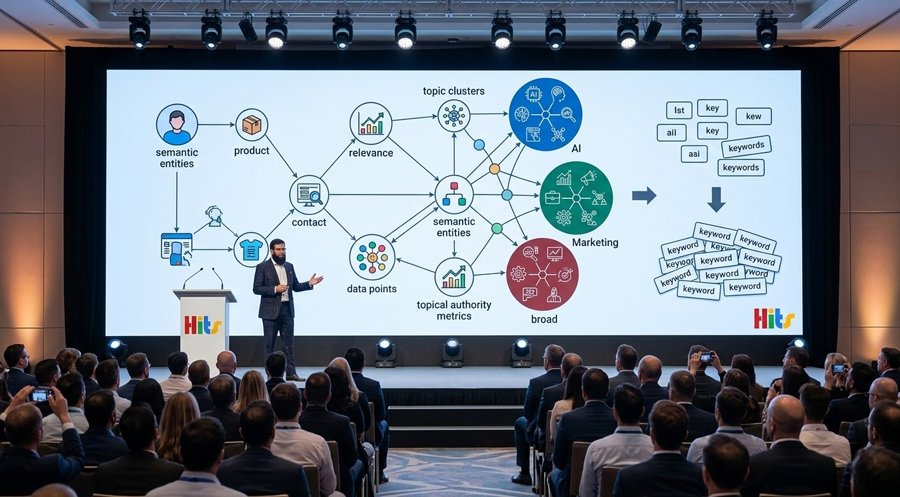
An entity is a specific thing: a person, place, brand, product, or concept. Google treats entities as building blocks of meaning.
Entity relationships are the connections between these things. For example:
- Nike (brand) → makes → running shoes (product)
- Flat feet (condition) → treated by → orthotics (solution)
- Boston Marathon (event) → held in → Boston (place)
Search engines build a web of these connections. When your content clearly shows these relationships, search engines trust it more.
How to Build Entity Relationships in Content
- Name entities clearly. Use full names, not vague pronouns, especially in the first mention.
- Connect entities with clear verbs. Show cause and effect, use and purpose.
- Use structured data (schema markup). This tells search engines directly what an entity is and how it relates to others on your page.
- Link related pages internally. This shows a network of connected topics on your own site.
A site that does this well earns something bigger than one ranking: it earns topical authority.
Topical Authority: The Real Goal
Topical authority means a search engine trusts your site as a reliable source on a specific subject. It is not built by one page. It is built by many connected pages that cover a topic in full depth.
Think of it like a library. One book on dogs does not make a library an expert on dogs. Hundreds of books covering breeds, training, health, and history do.
Signs of Strong Topical Authority
- Content covers a topic from many angles, not just one keyword.
- Pages link to each other in a logical structure (often called a topic cluster or hub-and-spoke model).
- Content answers follow-up questions a reader would naturally ask.
- External sites link back to your content as a trusted source.
- Content stays updated as facts and best practices change.
Building a Topic Cluster
A topic cluster has one main “pillar” page and several “cluster” pages linked to it.
Example structure for a running shoe site:
- Pillar page: “Complete Guide to Running Shoes”
- Cluster page 1: “Best Shoes for Flat Feet”
- Cluster page 2: “How to Measure Foot Pronation”
- Cluster page 3: “Running Shoe Lifespan and Replacement Guide”
Each cluster page links back to the pillar. The pillar links out to each cluster. This structure signals depth and organization to search engines.
Semantic Keyword Research: A New Method
Semantic keyword research goes beyond search volume numbers. It looks for related concepts, questions, and synonyms tied to a main topic.
Step-by-Step Process
- Start with a seed topic. Example: “semantic search SEO.”
- Find related questions. Use tools like Google’s “People also ask,” AnswerThePublic, or AlsoAsked.
- Check Google’s autocomplete and related searches. These reveal real phrasing people use.
- Study top-ranking pages. Note the subtopics they cover, not just their keywords.
- Map entities and LSI terms. LSI stands for Latent Semantic Indexing. These are related terms that add context, like “topical authority” or “entity relationships” for a semantic search article.
- Group findings into clusters. Sort ideas into pillar and supporting topics.
LSI Keywords: Still Useful, Differently Understood
LSI keywords are words closely related in meaning to your main topic. They are not exact synonyms. They are context clues.
For a page about “semantic search SEO,” LSI terms might include:
- Topical authority
- Entity relationships
- Google Knowledge Graph
- Structured data
- Search intent
Using these terms naturally helps search engines confirm what your page is really about. Note: modern research suggests Google’s systems today rely more on advanced language models than the older strict LSI concept, but the practical habit of covering related terms remains valuable.
The Google Knowledge Graph Explained
The Google Knowledge Graph is a massive database of entities and their relationships. Google launched it in 2012 to move search results beyond simple keyword matches.
When you search “Albert Einstein,” you often see a box on the right side of results with his photo, birth date, and key facts. That box comes from the Knowledge Graph.
How the Knowledge Graph Affects SEO
- It powers rich results like knowledge panels, featured snippets, and entity cards.
- It helps Google understand ambiguous searches (example: “Apple” the fruit vs. Apple the company).
- It rewards sites that clearly define entities using structured data.
- It connects your brand or content to a bigger web of trusted information.
Getting Your Site Recognized in the Knowledge Graph
- Use Schema.org structured data on your pages, especially Organization, Person, and Product schema.
- Keep information about your brand and key people consistent across your site, Wikipedia, LinkedIn, and other trusted sources.
- Build entity mentions and links from other authoritative sites.
- Maintain a Google Business Profile if you serve local customers.
- Use clear, factual language when introducing entities. Avoid vague or overly promotional wording.
Getting listed in the Knowledge Graph is not guaranteed. But consistent, structured, and accurate entity signals improve your chances over time.
Practical Checklist: Moving From Keywords to Semantics
Use this checklist to shift your SEO approach:
- Map your main topic into a pillar and cluster structure.
- Research related questions, not just keyword volume.
- Identify key entities relevant to your topic.
- Add schema markup to define those entities clearly.
- Link cluster pages to pillar pages, and back again.
- Cover follow-up questions readers are likely to ask.
- Update older content to add missing context and entities.
- Track rankings for topics and question clusters, not just single keywords.
Common Mistakes to Avoid
Mistake 1: Treating LSI keywords like a checklist. Stuffing related terms without real context still reads poorly to both readers and search engines.
Mistake 2: Ignoring internal linking. A pillar page without linked cluster content loses much of its topical strength.
Mistake 3: Skipping structured data. Without schema markup, search engines must guess at your entities instead of confirming them directly.
Mistake 4: Writing shallow content. A 300-word page rarely shows topical depth, no matter how well-researched the keywords are.
Mistake 5: Forgetting search intent. Matching a keyword means little if the content does not answer why someone searched it in the first place.
Semantic Search SEO
How meaning replaced keywords in modern search
Keyword SEO
- Matches exact phrases
- Repeats one keyword
- One page per term
- Fades as algorithms grow
Semantic SEO
- Matches user intent
- Covers related entities
- One hub, many questions
- Builds lasting authority
3 Pillars of Semantic SEO
Entity Relationships
How things connect: brand, product, place
Topical Authority
Deep, connected content earns trust
Knowledge Graph
Google’s map of facts and entities
Need a semantic SEO strategy? webseowrite.pk can help.
Consult Our TeamFrequently Asked Questions
Is keyword research still necessary with semantic search SEO?
Yes. Keywords still show what people search for. Semantic SEO builds on that data by adding related concepts, entities, and questions around each keyword.
Do I need to remove keywords from my old content?
No. Keep your keywords. Add supporting context, related entities, and internal links to strengthen the page’s meaning.
How long does it take to build topical authority?
It varies by niche and competition. Most sites see meaningful gains within three to six months of consistent, structured content publishing.
Does schema markup guarantee a Knowledge Graph listing?
No. Schema markup helps search engines understand your entities, but a Knowledge Graph listing depends on many trust and authority signals over time.
Can small or local businesses use semantic search SEO?
Yes. Local businesses benefit strongly from entity-based SEO, especially through Google Business Profile and consistent brand information across the web.
Final Thoughts
Semantic search SEO is not a trend. It is how modern search actually works. Keywords still matter, but they are only the starting point. Entities, relationships, and topical depth carry the real ranking weight today.
Sites that build structured topic clusters, use clear entity signals, and align with tools like the Google Knowledge Graph will hold stronger, longer-lasting rankings.
Technical SEO consultants and digital strategists who adopt this approach early will stay ahead of competitors still stuck on outdated keyword tactics.
If your team needs a hands-on partner to plan and execute a semantic SEO strategy, webseowrite.pk can help you consult on a high-level SEO project. Reach out through webseowrite.pk’s contact page to start the conversation: https://webseowrite.pk/contact/
👉 For more information about the topic, contact the expert now!