
Table of Contents
The AI Citation Playbook: 7 Blueprints to Get Your Brand Recommended by ChatGPT, Perplexity, and Google AIO
The digital landscape of 2026 has crossed a definitive threshold. We have moved from the “Era of Discovery” (where users browsed links) to the “Era of Synthesis” (where AI summarizes your worth).
If ChatGPT, Gemini, or Perplexity aren’t citing you, you are becoming a ghost in your own industry. Research indicates that 42% of B2B decision-makers now use an LLM (Large Language Model) as the very first step in their buying journey. Furthermore, traffic referred from AI citations has a 4.4x higher conversion rate than traditional search, because by the time they click, the AI has already vouched for you.
At HITS Web SEO Write, we’ve spent the last year deconstructing the “Black Box” of AI recommendation engines. Getting mentioned isn’t about keyword stuffing; it’s about building a digital reputation moat.
🧠 Beyond the Blue Link: How AI Search Actually Works
Traditional SEO was about ranking. AI Search (often referred to as GEO—Generative Engine Optimization) is primarily about making recommendations.
AI models like ChatGPT don’t “index” the web in the traditional sense; they create a Co-Occurrence Network. They look at how often your brand is mentioned alongside specific problems, trusted publications, and positive community sentiment. If your brand is an “Entity” that consistently appears near “Trusted Solutions,” the AI creates a vector of authority that leads to a citation.
| Feature | Traditional SEO (Google) | AI Synthesis (GEO/AEO) |
| Primary Goal | Rank #1 for a keyword. | Be the “Trusted Answer” or cited source. |
| Currency | Backlinks (Domain Authority). | Citations & Mentions (Entity Trust). |
| Content Focus | Optimized for Googlebots. | Optimized for LLM Ingestion (BLUF). |
| Metric | Clicks and Impressions. | Share of Voice & Recommendation Count. |
🏗️ The 7 Core Blueprints to Earn AI Recommendations
1. The “Digital Entity” Blueprint: Master Your Unified Narrative
AI platforms are highly sensitive to information inconsistency. If your “About” page says one thing, your LinkedIn says another, and your Wikipedia entry (if you have one) is outdated, the AI experiences “High Perplexity.”
The Strategy:
- The Single Source of Truth: Ensure your brand bio, value proposition, and founder details are identical across all high-authority platforms.
- Knowledge Graph Seeding: Use JSON-LD Schema Markup (Organization, Person, Product) to explicitly tell the AI: “This is who we are, and this is what we do.”
2. The Sentiment Engine: Respond to Reviews Like an AI is Watching
AI models increasingly mine Reddit, Quora, and G2 to understand what real humans think. They aren’t just looking for a 5-star rating; they are analyzing sentiment vectors.
The Strategy:
- Keyword-Rich Responses: When responding to reviews, naturally include the services you provided.
- Bad: “Thanks for the feedback!”
- Good: “Glad we could help with your Next.js Web Design project in Lahore; it’s our specialty!”
- Community Validation: 48% of AI citations now come from community sources. Actively participate in subreddits related to your niche without being “salesy.”
3. Digital PR as the New Backlink (Co-Citation)
A backlink from an unknown site is worth almost nothing in 2026. However, a brand mention (even without a link) in a premium outlet like Forbes, TechCrunch, or a major Pakistani news site like Dawn or The News is pure gold.
The Strategy:
- The “Best of” Listicle Play: AI models love “Best of [Category]” articles. Reach out to publishers of these lists. If you aren’t on the list, you likely won’t be in the AI’s recommendation for “Top 5 [Services] in Pakistan.”
4. Intent Mapping: Dominate the MOFU & BOFU Content Tiers
“Top of Funnel” (TOFU) content—like “What is SEO?”—is now easily answered by the AI itself, often leading to zero clicks for you. The real visibility is in the Middle (MOFU) and Bottom (BOFU) of the funnel.
The Strategy:
- Comparison Frameworks: Create pages that compare your brand to competitors fairly. AI search engines use these heavily to help users make decisions.
- Solution-Specific Case Studies: Instead of generic blogs, publish “How we solved [Problem X] for [Industry Y].”
5. Information Gain Architecture: Create “Quote-Ready” Data
AI models are “Citation-Hungry.” They are looking for concrete evidence to support their summaries. If your content is just a rehash of what’s already out there, you have Zero Information Gain (IG).
The Strategy:
- Proprietary Statistics: Run a survey, analyze your own client data (anonymized), and publish the results.
- The BLUF Method: Use Bottom Line Up Front. Start every section with a 2-3 sentence executive summary. This makes it incredibly easy for an LLM to “scrape and quote” you.
6. The Extraction Framework: Technical SSR for LLM Crawlers
If an AI crawler (like GPTBot or PerplexityBot) hits your site and sees a blank page waiting for JavaScript to load, you are invisible.
The Strategy:
- Server-Side Rendering (SSR): Use frameworks like Next.js or Astro to ensure your HTML is pre-rendered and readable at the point of entry.
- The
llms.txtStandard: In 2026, many sites now include an/llms.txtfile (similar torobots.txt) specifically designed to give AI agents a concise, markdown-friendly map of your most authoritative content.
7. Multi-Platform Calibration: Different Engines, Different Biases
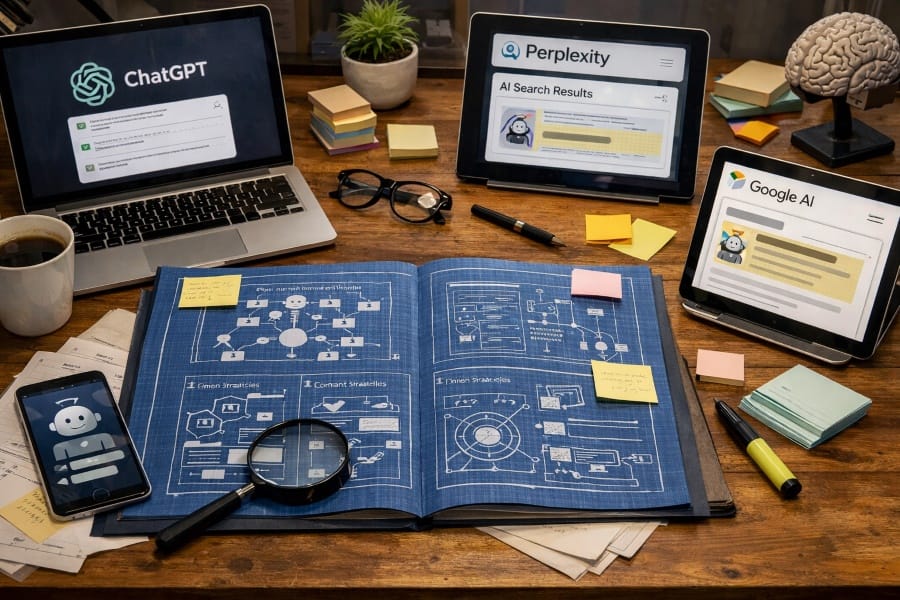
Not all AI is created equal. Your strategy must be nuanced for the “Big Three.”
| AI Platform | Data Bias | Best Optimization Strategy |
| ChatGPT (OpenAI) | Editorial & News focused. | High-quality PR and Wikipedia-style citations. |
| Perplexity | Real-time Web & Reddit. | Community seeding and fast-loading, structured news. |
| Google AIO / Gemini | Google Knowledge Graph. | Strong Technical SEO and E-E-A-T signals. |
Strategic Partnership: Scaling Your AI Visibility with HITS Web SEO Write
The complexity of the 2026 search requires a partner who understands that Web Design is SEO and Content is Data. In Pakistan, many agencies are still stuck in the 2018 playbook. HITS Web SEO Write is built for the Synthesis Era.
How We Secure Your AI Mentions:
- AI-Native Web Design: We don’t just build “pretty” sites. We use SSR (Server-Side Rendering) and Astro/Next.js architectures to ensure your site is a dream for AI crawlers to ingest.
- Entity-Based SEO: We move you beyond keywords. We build your brand’s presence in the Knowledge Graph, ensuring that when users ask for the “best SEO agency in Pakistan,” your name is the first one cited.
- High-Information-Gain Content: Our writers don’t produce fluff. We create the research papers, case studies, and structured data modules that AI engines want to quote.
Is your brand invisible to the engines that matter?
Would you like me to run an “AI Share of Voice” audit to see which of your competitors are currently stealing your mentions in ChatGPT and Perplexity? Contact us now for the consultation!