

Table of Contents
AI Search & The New SEO Paradigm: GEO, AEO, Zero-Click, and LLM Optimization — The Complete Guide
Traditional SEO alone is no longer enough to stay visible online. In 2026, Google AI Overviews appear in 47% of all searches. AI-driven traffic is growing 527% year-over-year and converts 4.4x better than standard organic traffic. The brands winning search visibility are no longer just those ranking at position #1 — they are those being cited, quoted, and recommended inside AI-generated answers. This guide explains exactly how to get there.
Why Is the SEO Paradigm Shifting So Dramatically in 2026?
The way people search has fundamentally changed. For three decades, search meant typing a query, receiving a list of blue links, and clicking through to a website. That model is being systematically replaced by one where an AI synthesizes multiple sources and delivers a direct answer — often without the user ever clicking a link.
The numbers tell the full story:
| Metric | 2026 Data | Source |
|---|---|---|
| Google AI Overviews appearing in searches | 47% of all queries | ClickForest |
| Traditional search volume drop predicted | 25–30% by end of 2026 | Gartner |
| Organic CTR drops when the AI Overview appears | 58% reduction | Ahrefs |
| AI search traffic growth (year-over-year) | 527% | ConvertMate |
| AI search traffic conversion vs. organic | 4.4x better | ConvertMate |
| Technology buyers trusting AI responses equally to Google | 80% | AnalyticaHouse |
| AI Overview citations from outside top 10 results | 83% | ConvertMate |
| Marketers planning to optimize for AI search | 92% | ConvertMate |
| Marketers currently optimizing for AI search | 40.6% | ConvertMate |
| Users combining AI + traditional search together | 77% | Semrush |
This is not a minor adjustment. It is the largest structural shift in search since Google replaced directory listings in the early 2000s.
What Is GEO (Generative Engine Optimization) — And Why Does It Matter?
Is GEO Replacing Traditional SEO?
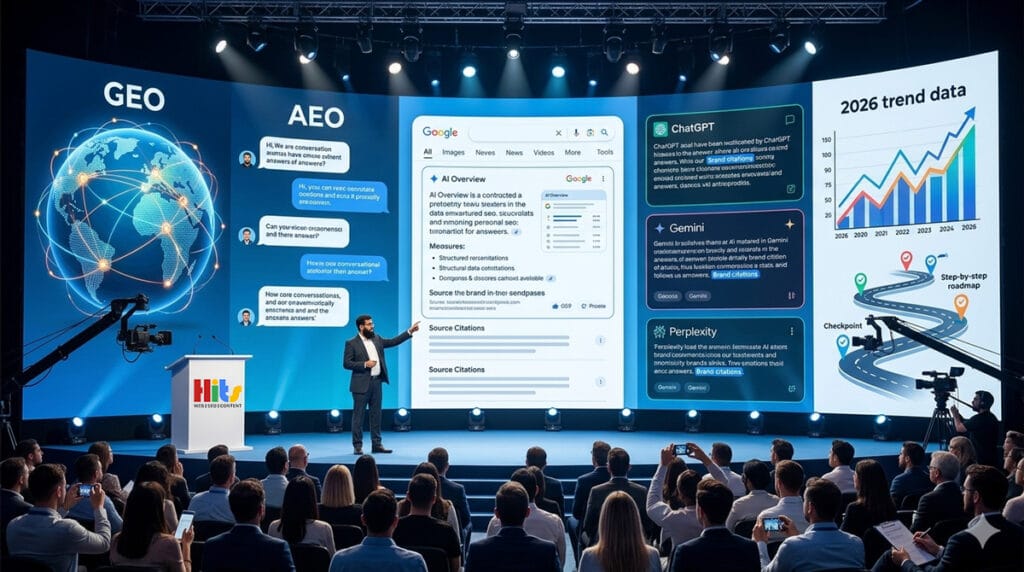
GEO is not replacing traditional SEO — it is being added on top of it. Generative Engine Optimization is the practice of structuring content and online presence so that AI engines like ChatGPT, Google AI Overviews, Perplexity, Gemini, and Claude choose to cite, quote, and reference your brand when generating answers. Unlike traditional SEO — which targets rank positions in a list of links — GEO targets the synthesis engines that build the answer itself.
The term was coined in 2023 by researchers at Princeton University, and by 2026, it had become a boardroom-level business strategy. The core insight: if you cannot capture the click, capture the citation.
How Did GEO Become So Important So Quickly?
The acceleration is driven by a simple user behavior shift. Users who once scrolled through pages of results are now asking an AI and receiving one direct, synthesized answer. The reliance on traditional search engines is projected to drop by as much as 25% through 2026 alone. For businesses, this means that a #1 ranking position — the holy grail of SEO for 20 years — now loses 58% of its click-through rate the moment an AI Overview appears above it.
The counterweight: pages that earn a citation inside the AI Overview can see CTR lifts of up to 35%. Being cited is the new ranking.
AEO vs. GEO vs. SEO: What Is the Difference and Which Should You Focus On?
What Does Each Optimization Discipline Actually Do?
These three disciplines operate at different layers of the search ecosystem. Understanding the difference prevents you from under-investing in the one your business needs most.
| Discipline | Full Name | Primary Target | Success Metric | Primary Focus |
|---|---|---|---|---|
| SEO | Search Engine Optimization | Google/Bing blue-link results | Rankings, organic traffic, clicks | Keywords, backlinks, technical health |
| AEO | Answer Engine Optimization | Featured snippets, voice search, and direct answer boxes | Zero-click visibility, position zero | Question-based structure, concise answers |
| GEO | Generative Engine Optimization | ChatGPT, Gemini, Perplexity, AI Overviews | AI citations, brand mentions in AI answers | Entity authority, data richness, cross-platform presence |
Do You Have to Choose Between SEO, AEO, and GEO?
No — and this is a critical point most guides get wrong. The three disciplines are layered, not competing. SEO builds the technical foundation and domain authority. AEO structures individual pages to win answer boxes and featured snippets. GEO operates at the brand level, making your entire digital footprint citation-worthy across every AI platform simultaneously.
Research from Jasper confirms: nearly 40% of Google AI Overview citations come from pages already ranking in the top 10 organic results, and nearly 70% rank in the top 100. Strong traditional SEO is still the foundation — GEO and AEO build on top of it.
The correct order of investment:
- Fix your technical SEO foundation first
- Restructure content for AEO (answer-based formatting)
- Layer GEO strategies on top (entity building, data richness, cross-platform authority)
How to Rank Inside Google AI Overviews: The Complete 2026 Optimization Playbook
What Does Google’s AI Actually Look for When Building an Overview?
Google’s AI Overview system evaluates pages differently from its traditional ranking algorithm. It is not just looking for pages that rank well — it is looking for pages that directly and clearly answer the query, quickly, with structured and verifiable information.
The six signals that drive AI Overview inclusion in 2026:
| Signal | What It Means | How to Optimize |
|---|---|---|
| Entity Strength | Is your brand recognized as an authority on this topic? | Build author profiles, brand mentions, and topic clusters |
| Content Structure | Can the AI extract a clear answer from your page? | Use question-based H2/H3 headers, direct answer blocks in first 200 words |
| Authority & Trust | Does your content have verifiable E-E-A-T signals? | Add expert bylines, citations, statistics with sources |
| Data Richness | Does your content include original stats, tables, and facts? | Publish original research, comparison tables, numbered findings |
| Freshness | Is your content recently updated? | Add “Last updated” dates, refresh statistics regularly |
| Machine Accessibility | Can AI crawlers efficiently parse your content? | Implement schema markup, structured HTML, and llms.txt file |
What Content Format Gets Cited Most by Google AI Overviews?
The PlushBeds case study — one of the clearest documented examples of AI Overview optimization — reveals the winning formula. After being invisible inside AI Overviews despite strong traditional rankings, PlushBeds rewrote its top commercial pages with:
- 50–70-word direct definition blocks at the top of each page
- Structured comparison tables
- FAQ sections tied to real “People Also Ask” queries
- FAQPage, Product, Review, and Organization schema in JSON-LD
- Person schema for in-house experts, linked to published bylines
The result: pages that were earning no AI citations began earning inclusion in AI Overviews — and CTR on those cited pages climbed by up to 35%.
What Is the First 200 Words Rule?
AI systems that use real-time retrieval — including Perplexity and Google AI Overviews — evaluate a page’s relevance primarily based on its opening content. The first 200 words of any article should directly and completely answer the primary query — not build up to the answer with introductory paragraphs. This is the single most impactful structural change most websites can make immediately.
Zero-Click Search Strategy: How Do You Win Brand Impressions When Google Never Sends a Click?
What Is Zero-Click Search and How Big Is the Problem?
Zero-click search refers to a Google search session that ends without the user clicking through to any external website — the answer is resolved directly on the results page through AI Overviews, featured snippets, or knowledge panels. According to SparkToro’s research, 58.5% of US Google searches already end without a click. For AI Overview-triggered queries, that figure climbs significantly higher.
This means visibility and traffic are no longer the same metric. A brand can appear prominently in search results — and in AI-generated answers — while receiving zero referral traffic from that appearance.
Is Zero-Click Search a Threat or an Opportunity?
Both. For brands that think about SEO purely as a traffic channel, it is a serious threat. For brands that understand search as a brand-building and trust-building channel, it is an enormous opportunity. Here is why:
- Users who see your brand cited inside an AI Overview develop brand awareness and trust — without visiting your site
- That trust shortens the consideration cycle when they search for your brand directly later
- AI-referred traffic, when it does arrive, converts at 4.4x the rate of standard organic traffic — because users already cleared a trust threshold before clicking.
What Tactical Moves Win Zero-Click Visibility?
To win zero-click impressions, structure your content to be extracted:
- Use clean HTML lists (
<ul>and<ol>) for step-by-step guides and comparisons - Structure comparisons in properly formatted HTML tables, not text paragraphs
- Put the direct answer to the user’s query in the first paragraph — never bury it
- Use the FAQ schema to answer common queries that resolve at the SERP level
- Publish quotable statistics and original data that AI systems reference repeatedly
- Build brand mentions across third-party publications, industry sites, and media
How to Become a Citation Source for AI Chatbots: ChatGPT, Gemini, and Perplexity
Why Do AI Chatbots Cite Some Brands and Not Others?
AI chatbots synthesize answers from multiple sources, but they do not cite randomly. They cite sources that meet a threshold of verifiable authority, content depth, and structural clarity. Unlike Google’s algorithm — which relies heavily on backlink signals — LLMs use vector-based retrieval systems that evaluate semantic relevance to the query and the trustworthiness of the content itself.
The Princeton University research that coined the term GEO found that specific optimization methods dramatically improve citation rates:
| GEO Optimization Method | Improvement in AI Citation Rate |
|---|---|
| Adding statistics and quantified data | +41% improvement |
| Adding expert quotations and attributions | +28% improvement |
| Fluency optimization (clear, well-structured writing) | Compounds other gains by 5.5%+ |
| Keyword stuffing (traditional SEO method) | No meaningful improvement |
What Steps Build Citation Authority Across AI Platforms?
Step 1 — Conduct a Citation Audit. Run five brand-relevant prompts inside ChatGPT, Gemini, Perplexity, and Google AI Overviews. Use queries your potential customers actually ask: “best [service] for [use case]”, “alternatives to [competitor]”, “how to [problem you solve]”. If your brand does not appear, you have a GEO gap to close.
Step 2 — Build Entity Recognition AI systems organize knowledge around entities — named things (brands, people, places, concepts) that they have learned to associate with specific topics. To be cited, your brand must be recognized as an entity in your niche. This requires consistent brand name usage across your site, a Wikipedia or Wikidata presence if possible, structured data with Organization and Person schema, and mentions across authoritative third-party sources.
Step 3 — Create Citation-Ready Content. Every article and page should include:
- Named experts with credentials and author bios
- Statistics with explicit sources and dates
- Original research, surveys, or proprietary data
- Comparison tables that AI can extract directly
- Clear declarative sentences that can stand alone as a quoted answer
Step 4 — Distribute Beyond Your Website AI chatbots pull from the broader web — not just your site. Guest posts on authoritative publications, media mentions, podcast transcripts, industry reports, and forum discussions all contribute to the corpus of content that AI systems draw from when generating answers.
Step 5 — Add an llms.txt File An llms.txt file at your site root is a plain-text instruction document that tells AI crawlers what your site covers, which pages are most authoritative, and how to interpret your content. It is the GEO equivalent of robots.txt for traditional search crawlers.
Information Voids Strategy: How to Find the Topics AI Cannot Answer and Own Them
What Is an Information Void and Why Is It a GEO Goldmine?
An information void is a topic or question where AI systems cannot yet provide a comprehensive, confident answer due to a lack of high-quality, consensus-level data in their training corpus or retrieval index. These voids represent the highest-opportunity territory in GEO — because when AI encounters an information void, it either says “I don’t know” or cites whatever thin content exists.
Publishing the definitive, data-rich answer to an information void question means your content becomes the default citation across every AI platform that surfaces it.
How Do You Find Information Voids in Your Niche?
Method 1 — Prompt Testing Systematically run topic-area prompts in ChatGPT, Gemini, and Perplexity. When the AI hedges, qualifies heavily, or says it cannot find reliable data, that is an information void.
Method 2 — Exploding Topics + Google Trends Use Exploding Topics and Google Trends to find fast-rising queries in your niche that have minimal existing high-quality content coverage.
Method 3 — People Also Ask Mining PAA questions that return thin or inconsistent AI answers are information voids. Target them with comprehensive, data-backed content.
Method 4 — Competitor Gap Analysis: Analyze what topics your top-ranking competitors have not published original data on. Their content gap is your citation opportunity.
Information Void Content Requirements: To fill a void effectively, your content must include original data (a survey, study, test, or analysis), a clear methodology, named expert commentary, structured formatting for easy AI extraction, and regular freshness updates so the data remains current.
LLM SEO: How to Optimize Your Content to Be Recommended by Large Language Models
What Is LLM SEO and How Is It Different from Standard GEO?
LLM SEO is the discipline of optimizing content specifically for citation inside large language model interfaces — primarily ChatGPT, Claude, and Gemini — rather than real-time retrieval systems like Google AI Overviews and Perplexity. The distinction matters because LLMs that generate answers from pre-trained knowledge (rather than live web retrieval) rely on a different set of signals to decide what to recommend.
For LLM SEO, the primary goal is to make your brand and content part of the model’s learned knowledge — not just its live search results. This requires consistent, long-term brand signal building across the web.
What Are the Six Core LLM SEO Signals in 2026?
| LLM SEO Signal | Description | Priority Level |
|---|---|---|
| Entity Strength | Your brand is a recognized named entity in your category | Critical |
| Content Authority | You publish original, expert-level content on your topic | Critical |
| Structured Data | Schema markup helps models parse your content accurately | High |
| Freshness | Recently dated content is preferred for time-sensitive topics | High |
| Content Depth | Comprehensive topic coverage outperforms surface-level posts | High |
| Machine Accessibility | llms.txt, clean HTML, crawlable structure | Medium |
How Long Does LLM SEO Take to Work?
According to agency data from 2POINT, most brands see early citation lifts inside AI platforms within 60 to 90 days of restructuring content, adding schema markup, and earning two or three category-relevant third-party placements. Compounding authority — where your brand becomes a go-to citation across multiple platforms — takes 6 to 9 months of consistent execution.
What Metrics Do You Track for LLM SEO Performance?
Traditional SEO metrics (rankings, traffic, backlinks) are necessary but insufficient for measuring LLM SEO success. The complete 2026 measurement framework includes:
| Traditional Metrics | New AI-Era Metrics |
|---|---|
| Organic rankings | Citation share in AI Overviews |
| Click-through rate | Brand mentions in AI-generated answers |
| Organic traffic | AI-referred traffic (from ChatGPT, Perplexity links) |
| Backlink count | Unlinked brand mentions across the web |
| Keyword rankings | Entity recognition across AI platforms |
The Complete GEO + AEO + SEO Action Roadmap for 2026
Where Do You Start if You Are Doing This for the First Time?
Month 1–2: Foundation
- Conduct a full technical SEO audit — fix crawl errors, Core Web Vitals, and indexation issues
- Run citation audit across ChatGPT, Gemini, Perplexity, and Google AI Overviews
- Add Organization, Person, Article, and FAQPage schema markup across all key pages
- Rewrite the first 200 words of your top 10 pages as direct answer blocks
- Add an llms.txt file to your site root
Month 2–4: Content Restructuring
- Restructure existing content with question-based H2/H3 headers
- Add comparison tables, numbered lists, and expert-quoted statistics to all key articles
- Build out topic clusters around your core subject areas
- Publish at least one piece of original data-driven research in your niche
Month 4–6: Authority Building
- Pursue guest placements on authoritative publications in your niche
- Build author profiles with credentials, photos, and linked social profiles
- Systematically pursue brand mentions across industry publications, forums, and directories
- Optimize your Google Business Profile and all local citations (especially for local SEO)
Month 6–9: GEO Maturity
- Monitor citation share monthly across all major AI platforms
- Identify and fill information voids with original research content
- Expand into adjacent topic areas to extend topical authority
- Track AI-referred traffic in GA4 and multi-touch attribution models
Key Takeaways
- Google AI Overviews now appear in 47% of all searches — making GEO non-optional for any serious digital strategy
- GEO, AEO, and SEO are layered disciplines — not competitors. SEO is the foundation; AEO and GEO build on top
- 83% of AI Overview citations come from pages outside the traditional top 10 — the playing field has opened
- AI-referred traffic converts 4.4x better than standard organic because users arrive pre-sold on trust
- The first 200 words of every page must directly answer the primary query — AI systems evaluate opening content first
- Original data, named expert quotes, and statistics improve AI citation rates by 28–41% (Princeton/GEO research)
- LLM SEO takes 60–90 days for early citations and 6–9 months for compounding authority
- The zero-click era demands a new primary metric: citation share and brand impressions, not just rankings and clicks
Struggling to Show Up in AI Search? Here Is Who Can Help.
Why Most Businesses Are Invisible to AI in 2026 — And How to Fix That
The gap between businesses that understand GEO and those that are still running 2022-era SEO is widening fast. With 92% of marketers planning to optimize for AI search but only 40.6% currently doing so, the window to build first-mover citation authority in your niche is still open — but it is closing.
Getting this right requires three things working together: a technically sound website that AI crawlers can read, content structured to earn citations, and an ongoing SEO and content strategy that builds authority month after month. That is exactly what HITS Web SEO Write delivers.
About HITS Web SEO Write — SEO, Web Design & Content Writing in Pakistan
HITS Web SEO Write is a Pakistan-based digital services company built around three tightly integrated capabilities that most agencies treat as separate silos:
| Service | What We Do for You |
|---|---|
| Advanced SEO Services | Technical SEO audits, Core Web Vitals fixes, GEO and AEO strategy, schema markup, topical authority building, and AI search optimization — built around your ranking goals |
| WordPress Web Design | Performance-first, SEO-aligned website builds using the right architecture for AI crawlability, Core Web Vitals compliance, and structured data implementation |
| SEO Content Writing | Data-rich, expert-authored articles, landing pages, and topic cluster content written to earn AI citations — not just rank positions |
Why the Integration Matters for GEO
GEO success is not a single-department job. The content team needs to write in citation-friendly formats. The technical SEO team needs to implement schema and llms.txt correctly. The web design team needs to build page structures that AI systems can parse efficiently. When these three are siloed across different agencies, critical gaps appear — and AI systems exploit those gaps by citing your competitors instead.
At HITS Web SEO Write, your SEO strategy, content plan, and web architecture are designed together from day one. The result is a digital presence that earns authority in traditional search and in AI-generated answers — consistently, and at a fraction of the cost of managing three separate vendors.
Who We Serve
- Businesses across Pakistan that want to build genuine AI search visibility before their competitors do
- eCommerce and WooCommerce stores that need SEO-optimized product content paired with GEO-ready site architecture
- Professional services firms (law, finance, healthcare, consulting) where E-E-A-T and AI citation authority directly influence client acquisition
- International clients who need professional-grade GEO, SEO, and content strategy at competitive Pakistan market rates
Ready to Become a Citation Source in Your Niche?
Whether you are starting your GEO journey from scratch, auditing an existing site for AI search readiness, or building a topic cluster strategy to dominate your niche, HITS Web SEO Write can assess your position and build the roadmap.
HITS Web SEO Write | SEO · Web Design · Content Writing | Pakistan Helping businesses rank in Google — and get cited by AI.