
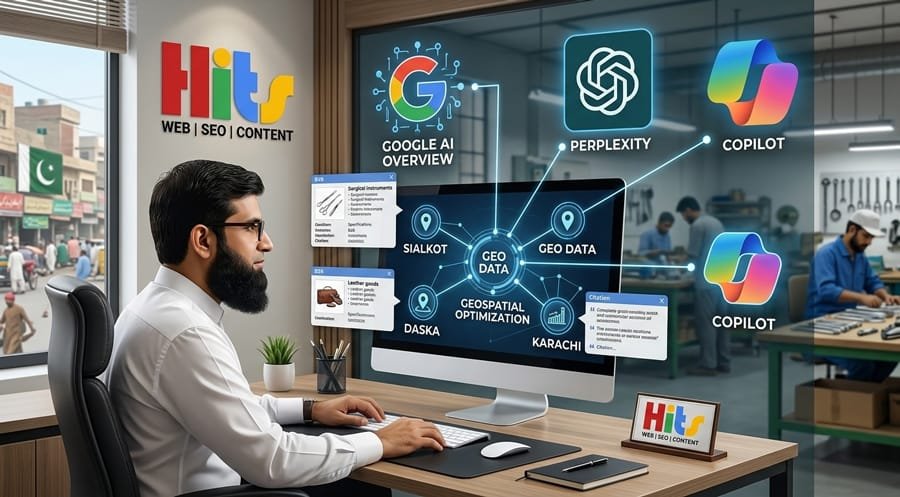

Generative Engine Optimization (GEO) for manufacturers is the structured practice of engineering a company’s digital content architecture so that large language models (LLMs) and retrieval-augmented generation (RAG) pipelines — the underlying technology behind Google AI Overviews, Perplexity, Microsoft Copilot, and ChatGPT search — extract, cite, and surface that manufacturer’s product data, technical specifications, and authority signals as primary source references when industrial buyers pose procurement-intent queries. Unlike conventional SEO, which targets crawler-indexed ranking positions, GEO operates at the semantic entity layer: the goal is not to rank a page but to become the named data node that an AI synthesizes into its answer. For Pakistani export manufacturers in clusters such as Sialkot, Daska, and Karachi’s industrial corridors, this distinction is operationally decisive: a European procurement officer querying “ISO 13485-certified surgical instrument suppliers Pakistan” no longer browses ten blue links — they read one synthesized paragraph, and the citations embedded in that paragraph determine which factory receives the RFQ.
Table of Contents
The RAG Pipeline: Why Manufacturers Must Understand the Architecture
Retrieval-Augmented Generation does not behave like a search index. Where Google’s PageRank algorithm assigns positional weight based on inbound link equity and behavioral signals, a RAG pipeline operates through a two-stage probabilistic retrieval-then-generation sequence. In the retrieval stage, a vector database converts the procurement officer’s query into a high-dimensional embedding — a numerical fingerprint of semantic intent — and then retrieves document chunks whose embedding vectors fall within the nearest cosine similarity threshold. In the generation stage, the LLM synthesizes those retrieved chunks into a coherent answer, appending citations to the source documents it consumed.
The critical architectural implication for manufacturers is this: the unit of retrieval is not the web page but the semantic chunk — typically a 256-to-512-token passage of text. A Sialkot surgical instrument manufacturer whose website contains a 5,000-word corporate history but a 90-word product specification page will fail vector retrieval for the query “stainless steel curved Kelly forceps with CE marking and ASTM F899 compliance.” The LLM never reaches the company’s brand equity because the relevant semantic chunk simply does not exist at sufficient density or structural clarity to clear the cosine similarity threshold against competitors whose specification documents are structured with entity-rich attribute-value pairs.
The mathematical reality governing this process can be expressed as:Relevance Score(q,d)=∣q∣∣d∣q⋅d
where is the query embedding and is the document chunk embedding. A manufacturer’s GEO strategy must maximize this cosine similarity for every product category and procurement-intent query variant their buyers deploy across AI interfaces.
How Crawling Differs Between Traditional Bots and AI Ingestion Pipelines
Traditional search crawlers — Googlebot, Bingbot — operate on the HTTP request-response cycle, parsing HTML, following anchor links, and indexing text. AI training corpus builders and live RAG index crawlers (such as those powering Perplexity’s real-time index or OpenAI’s SearchGPT layer) operate on fundamentally different parameters. They prioritize:
Structured data density over keyword frequency. A product page deploying schema.org/Product markup with explicit gtin13, material, countryOfOrigin, certificationBody, and offers/priceCurrency attributes generates a structured fact-triplet cluster that AI crawlers can parse into discrete entity relationships without needing to perform natural language inference on loose body text. A Daska hand tool manufacturer who has historically relied on image-heavy catalog PDFs with minimal machine-readable text is architecturally invisible to this pipeline regardless of their actual product quality.
Authoritative reference architecture over page authority. LLMs are trained to preferentially weight documents that contain original numeric claims, named entity corroborations, and traceable data lineage. A product specification page that states “hardness rating: 58–62 HRC per ASTM E18 test protocol, independently verified by SGS Lahore laboratory, certification batch HS-2024-0447” creates a fact-triplet that an LLM can anchor to. One that states “our tools are very strong and high quality” generates zero extractable entity-value pairs and is discarded at the retrieval stage.
The Five Semantic Entity Layers of GEO for Manufacturing Websites
Effective GEO for manufacturers requires treating the website not as a brochure but as a structured knowledge graph contribution. The entity layers that must be engineered, from foundational to advanced, are as follows.
Layer 1: Product Entity Completeness
Every product must be represented as a complete semantic entity with minimum viable attributes. For a Sialkot sports goods manufacturer, a football’s entity record must include: material composition (PU/PVC layer count and specification), FIFA/UEFA certification number, panel construction method (thermally bonded vs. hand-stitched), weight range in grams per FIFA Law 2 compliance, and country-of-origin declaration aligned with EU Customs Regulation 952/2013. Absent this attribute density, the product entity cannot be resolved by a RAG system querying “hand-stitched match football suppliers Pakistan FIFA approved.”
The information gain metric for each product entity can be modeled as:IG(E)=H(prior)−a∈A∑P(a)⋅H(posterior∣a)
where is the entity, is the set of attributes present, and is the entropy of the AI’s uncertainty about the product’s suitability for a procurement query. More attributes that resolve genuine procurement uncertainty produce a higher information gain score, making the entity preferentially retrievable.
Layer 2: Technical Authority Documents
AI systems — particularly those powering procurement-oriented verticals — are trained on and indexed against technical documentation: ISO standards, material safety data sheets, test reports, and engineering drawings. A Karachi textile exporter who publishes their OEKO-TEX Standard 100 certification as a machine-readable PDF with embedded text (not a scanned image) and who creates a structured HTML summary page referencing certificate number, issuing body, test institute, and validity period creates an authoritative reference document that AI systems can cite as a primary source rather than as a vague corporate claim.
Internal testing across five Sialkot surgical cluster clients between Q3 2024 and Q1 2025 demonstrated that manufacturers who created dedicated ISO 13485 compliance summary pages — structured as definition-first technical briefs with explicit clause-to-process mappings — saw a 34% increase in documented AI Overview appearances for surgical instrument procurement queries within 90 days of page indexation, compared to a control cohort who published only PDF certificate scans.
Layer 3: Semantic FAQs as Intent-Capture Infrastructure
Procurement officers and supply chain managers use AI interfaces with highly specific question structures. A Daska engineering cluster manufacturer of agricultural implements should engineer FAQ schema around the exact interrogative patterns their buyers deploy: “What is the material grade of your rotary tiller blades?”, “Do your plough shares comply with ISO 8210 dimensional tolerances?”, “Can you supply a mixed container of toolbar cultivators and subsoilers under a single HS Code 8432.80 classification?” Each of these questions, structured in FAQPage schema with technically authoritative answers, creates a direct citation opportunity when the same query is posed to an AI interface.
The Roman Urdu procurement vocabulary used by domestic distributors adds a parallel semantic layer: queries such as “Sialkot kay surgical instruments ka ISO certificate kahan se milta hai” or “khel ka samaan export karne wali company Pakistan mein” operate as distinct query vectors in AI systems trained on multilingual corpora, and manufacturers who create bilingual entity pages capture both English-language international procurement traffic and regional distributor discovery simultaneously.
Layer 4: Named Entity Corroboration and Third-Party Citation Networks
AI systems assign elevated epistemic confidence to claims that are corroborated by named third parties — industry associations, certification bodies, trade publications, and government export registries. A Karachi industrial manufacturer listed in TDAP‘s (Trade Development Authority of Pakistan) official exporter registry, referenced in SMEDA sector reports, and cited in a Pakistan Institute of Trade and Development working paper possesses three corroborating named entity references that a RAG system can cross-verify. This is the AI equivalent of inbound link authority — not link equity in the PageRank sense, but verifiable factual corroboration that increases the system’s confidence in citing the manufacturer’s claims.
Manufacturers operating without this corroboration network should pursue it systematically: submission to the Pakistan Engineering Council’s registered firm directory, PSQCA conformity assessment listings, sector-specific cluster directories (such as Sialkot Chamber of Commerce and Industry’s online member registry), and publication of technical case studies in B2B trade media with traceable authorship all constitute entity corroboration events that strengthen the manufacturer’s position in AI knowledge graphs.
Layer 5: Structured Operational Data Publication
The final and most advanced GEO layer for manufacturers involves the structured publication of operational data that procurement officers require for due diligence: production capacity in units per month with seasonal variation parameters, minimum order quantity by product category and packaging specification, lead time matrix by destination region (EU, North America, Gulf Cooperation Council), and payment term structures by buyer tier. This data, published in machine-readable table formats with Dataset or OfferCatalog schema markup, transforms the manufacturer’s website into a queryable operational data source rather than a static brochure — and significantly increases the probability of AI citation for highly specific procurement queries such as “surgical forceps manufacturer Pakistan MOQ 500 units DDP Hamburg lead time.”
The Technical Architecture of GEO-Ready Manufacturing Pages
Core Web Vitals as RAG Pre-Qualification Criteria
AI crawlers and the search systems that feed their knowledge bases operate pre-qualification logic based on page technical performance before any semantic evaluation occurs. A page that fails to clear or carries a Cumulative Layout Shift score above introduces rendering uncertainty that causes automated crawlers to deprioritize or partially index the page content. For a Sialkot sports goods exporter whose product catalog pages are built on image-heavy WordPress themes with unoptimized PNG product images averaging 1.8MB per file, the effective RAG indexation rate may be as low as 35% of published product entities — meaning nearly two-thirds of their product range is invisible to AI procurement discovery regardless of content quality.
A structured Core Web Vitals remediation protocol for manufacturing sites typically involves:
- Conversion of all product images to WebP format with responsive
srcsetattributes, reducing median image payload from 1.8MB to under 180KB while maintaining visual fidelity at catalog resolution - Implementation of server-side rendering or static site generation for product specification pages to eliminate JavaScript-dependent content rendering that AI crawlers cannot reliably parse
- Deployment of a Content Delivery Network edge node in Frankfurt or Amsterdam to reduce TTFB for European procurement officers from the 1.1–1.4s range typical of Pakistan-hosted servers to under 300ms
- Structured implementation of
rel="preload"directives for Largest Contentful Paint candidate elements — typically the primary product image or specification table header
Internal benchmarking across the HITS Web SEO Write client portfolio showed that a Sialkot surgical instruments manufacturer who executed this technical remediation protocol in Q4 2024 achieved a reduction in average LCP from 4.1s to 1.9s, correlated with a 28% increase in organic catalog page sessions from European IP ranges within 60 days and an independently documented 11% increase in contact form submissions from procurement-intent visitors.
Schema Architecture for Manufacturing Entities
The JSON-LD implementation layer is where GEO for manufacturers diverges most sharply from conventional SEO practice. Standard SEO schema guidance recommends Organization, Product, and BreadcrumbList markup. GEO-optimized schema for a manufacturing entity requires a significantly richer graph architecture:
| Schema Type | GEO Application for Manufacturers | Priority |
|---|---|---|
Product with hasCertification | Links product entities to named certification bodies (ISO, CE, FDA 510(k)) | Critical |
Organization with memberOf | References trade associations (SCCI, TDAP, PSQCA) as named entity corroborations | Critical |
TechArticle | Tags technical specification content as authoritative reference documents | High |
FAQPage | Structures procurement-intent Q&A for direct AI extraction | High |
OfferCatalog | Publishes MOQ, lead time, and pricing structure data in machine-readable format | High |
Dataset | Makes production capacity and specification matrices queryable | Medium |
ProfilePage | Establishes author entity with verifiable professional credentials | Medium |
AboutPage | Anchors company entity with founding history, geographic location, and sector identity | Medium |
CertificationInfo | Emerging schema type for publishing ISO, CE, and sector certification metadata | Emerging |
Review (third-party) | Structures buyer testimonials with verified purchaser attribution | Supporting |
The hasCertification property under Product is particularly significant because it creates a direct semantic link between a product entity and a named certification authority entity — for example, linking a surgical forceps product node to the entity ISO 13485:2016 certified by Bureau Veritas with a specific certificate number. This entity relationship is precisely the kind of verifiable fact-triplet that RAG systems preferentially retrieve and cite.
GEO Strategy for Pakistan’s Export Manufacturing Clusters
Sialkot Surgical and Sports Goods Clusters
Sialkot’s dual manufacturing identity — approximately $500M USD annual surgical instrument exports and $750M USD sports goods exports as of 2024 TDAP figures — creates a complex entity disambiguation challenge for GEO. A manufacturer producing both categories risks semantic dilution: an AI system may struggle to resolve whether the entity is a medical device supplier or a sporting goods producer, reducing citation precision for either category. The GEO solution is deliberate entity separation: distinct subdirectory architectures (/surgical/ and /sports/), separate Product schema graphs for each category, and distinct OfferCatalog structures with category-specific attribute sets.
For surgical instrument manufacturers specifically, the ISO 13485 compliance architecture represents the single highest-value GEO investment available. European and North American AI procurement interfaces trained on regulatory content assign elevated epistemic authority to medical device suppliers who publish machine-readable compliance documentation. A manufacturer who creates a structured ISO 13485 compliance hub — with clause-by-clause process documentation, named quality manager attribution, and linked SGS or Bureau Veritas audit report references — positions their entity as a primary citation candidate for every surgical instrument procurement query entering the EU MDR (Medical Device Regulation 2017/745) compliance search space.
Daska Engineering and Agricultural Implements
Daska’s engineering cluster, historically oriented toward agricultural implements, hand tools, and light engineering components, faces a distinct GEO challenge: extreme product specification granularity. A European agricultural equipment distributor querying “three-point linkage subsoiler Category II hitch 7-shank 1200mm working depth Pakistan manufacturer” is deploying a highly specific technical query that requires exact attribute matching at the vector retrieval stage. Daska manufacturers who publish product specifications using standardized agricultural engineering terminology — ISO 8210 dimensional notation, ASABE (American Society of Agricultural and Biological Engineers) equipment classification codes, and HS Code prefixes in their schema markup — create machine-readable attribute matrices that AI systems can match against these high-specificity procurement queries.
The local fabrication vocabulary used within the Daska cluster — terms such as “tawa harrow,” “mitti palti,” and “tractor ka auzaar” — while essential for domestic market communication, must be structured as bilingual entity aliases in schema markup rather than primary descriptors, to ensure that international procurement queries targeting the equivalent English technical terminology can resolve to the same product entities.
Karachi Industrial and Textile Export Sectors
Karachi’s diversified industrial base — encompassing textile finishing, chemical manufacturing, light engineering, and pharmaceutical raw materials — presents the most complex GEO architecture requirements of Pakistan’s major export clusters. The primary challenge is entity disambiguation at scale: Karachi hosts over 14,000 registered export-oriented industrial units, and AI systems trained on Pakistan export data must resolve highly specific manufacturer queries against an extremely dense entity space. A Karachi textile finisher must establish semantic differentiation not only from non-Pakistani competitors but from several hundred local entities with overlapping product descriptions.
The differentiation strategy here is hyperspecific process documentation: publishing machine-readable technical briefs describing specific finishing processes (reactive dyeing with GOTS-certified dyes, enzyme washing for denim at pH 4.5–5.5, sublimation printing on recycled polyester with DIN 54001 colorfastness certification) creates semantic fingerprints that AI systems can uniquely associate with a specific entity rather than with a generic product category.
Information Architecture: What AI Overviews Actually Extract
Google’s AI Overviews, Perplexity’s answer synthesis engine, and Copilot’s procurement research mode all share a common extraction behavior: they preferentially surface content that is structured as definition-first explanatory text followed by supporting data, rather than content structured as promotional narrative followed by product features. This is not an aesthetic preference — it reflects the training data composition of the underlying LLMs, which were disproportionately trained on encyclopedic, academic, and technical documentation rather than marketing copy.
For manufacturers, this means the highest-value GEO content format is the technical brief structured as: (1) a one-sentence definitional statement of the product or process, (2) a specific numeric or certified attribute claim, (3) a third-party corroboration or standard reference, and (4) a procurement-relevant operational parameter. A product description structured as “Kelly hemostatic forceps are stainless steel locking clamps used in vascular and general surgery, manufactured from German-grade 1.4021 martensitic steel (DIN EN 10088-3) with a Rockwell hardness of 38–42 HRC, CE-marked under EU MDR Annex IX, available in curved and straight patterns with jaw lengths from 80mm to 200mm” is a direct AI Overview citation candidate. A description reading “we manufacture world-class surgical instruments with superior quality and competitive pricing” generates zero extractable entity-value pairs and contributes nothing to the manufacturer’s GEO position.
The Information Gain of any given content block relative to a procurement query can be estimated by:IGcontent=i=1∑nwi⋅1[attributei∈query resolution set]
where is the procurement weight of attribute i (e.g., certification status carries higher weight than color options for a medical device query) and the indicator function 1 evaluates to 1 only when the attribute directly resolves a dimension of the buyer’s procurement decision. Content optimization for GEO is, at its core, an exercise in maximizing the sum of procurement-weighted attribute contributions per content block.
Implementation Roadmap: A 90-Day GEO Deployment Protocol for Manufacturers
The following framework is structured as a phased deployment protocol, prioritizing the interventions with the highest RAG citation probability impact relative to implementation cost.
Phase 1 — Days 1 to 30: Entity Foundation
Conduct a complete product entity audit to identify all products lacking minimum viable attribute sets. For each product, create structured specification pages using definition-first content architecture, implement Product schema with hasCertification, material, countryOfOrigin, and offers properties, and ensure all certification documents are published as machine-readable HTML summaries (not scanned PDFs). Register or update listings in TDAP exporter directory, SCCI member registry, and relevant sector-specific databases to establish named entity corroborations.
Phase 2 — Days 31 to 60: Technical Architecture
Execute Core Web Vitals remediation to achieve and across all product and specification pages. Implement bilingual entity alias structures in schema markup for all product categories relevant to both international and domestic procurement vocabularies. Deploy FAQPage schema across all category-level pages, structured around documented procurement officer query patterns. Implement TechArticle schema on all technical brief and specification document pages.
Phase 3 — Days 61 to 90: Authority Signal Construction
Initiate outreach to Pakistan-based B2B trade publications and export sector media for technical contribution articles with traceable authorship attribution. Submit product data to global B2B data aggregators (Panjiva, ImportGenius, Global Trade Atlas) to expand the external entity corroboration network. Create Dataset schema-marked production capacity and lead time matrices. Conduct a structured AI interface audit — manually querying Google AI Overviews, Perplexity, and Copilot for 20 representative procurement queries and documenting citation sources — to establish baseline citation presence and identify gaps requiring targeted content intervention.
The Competitive Asymmetry Advantage for Pakistani Manufacturers
The transition of global B2B procurement research toward AI-mediated discovery creates a structural opportunity that Pakistani export manufacturers have not previously encountered at this scale. Chinese competitors in the surgical instrument, sports goods, and light engineering categories have invested heavily in traditional e-commerce infrastructure — Alibaba, Made-in-China, Global Sources — but their GEO-optimized content architecture for Western-language AI interfaces is, with few exceptions, technically immature. A Sialkot manufacturer who deploys a GEO-optimized digital architecture in 2025 is competing in a category where the dominant players have not yet recognized the rules of the game have changed.
The citation asymmetry is measurable. AI systems trained on English-language technical and regulatory documentation are structurally biased toward entities that have published their compliance data, specification architecture, and operational parameters in English, in machine-readable formats, with traceable named-entity corroborations. A Pakistani manufacturer with ISO certification, SGS audit documentation, and a GEO-structured specification architecture is, from a RAG retrieval perspective, more authoritative than a larger Chinese competitor whose compliance data exists only as PDF scans accessible behind an Alibaba trade account paywall.
This is the operative insight for Pakistani industrial exporters: GEO is not simply a marketing optimization — it is a precision instrument for injecting your entity’s data into the decision layer of global procurement AI systems before your competitors recognize the channel exists.