

Table of Contents
The Post-Search Era: Mastering Agentic AI Optimization (AEO)
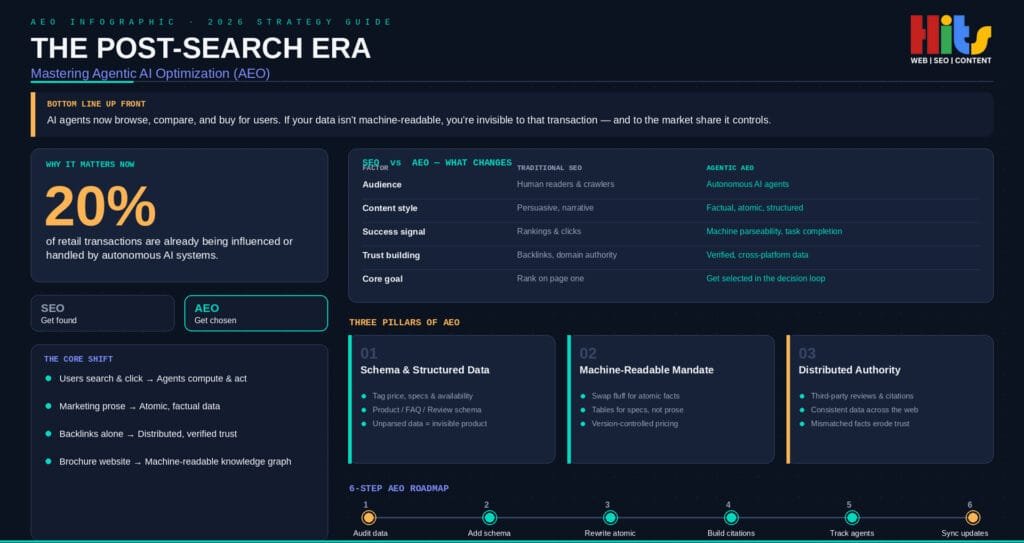
Search is changing. AI agents now browse, compare, and buy on behalf of users. If your website isn’t built for machines to read, you’re invisible to a growing share of buyers. This guide compares traditional SEO with Agentic Engine Optimization (AEO), shows you what to fix first, and gives you a practical roadmap for 2026.
What Is Agentic Search, and Why Should You Care?
Agentic search is different from typing a query into Google. An AI agent — like a shopping assistant or a research bot — doesn’t just find links. It reads your content, extracts facts, compares you to competitors, and takes action. That action might be adding your product to a cart, recommending a vendor, or skipping you entirely.
This is a shift from “search and click” to “compute and act.” Users are stepping back. Agents are stepping in.
For CMOs, e-commerce founders, and SEO strategists, this changes the job. You’re no longer just writing for a human reader scrolling a page. You’re structuring data for a machine deciding in milliseconds.
Industry analysts increasingly cite rising agent-assisted commerce as a factor in online retail, though exact figures vary by source and are still being validated as the technology matures. What’s not in dispute is the direction: autonomous agents are becoming a real distribution channel, and brands unprepared for it are already losing visibility in agent-driven results.
SEO vs. AEO: A Side-by-Side Comparison
Traditional SEO and Agentic Engine Optimization share some DNA — both care about relevance, authority, and trust. But the mechanics diverge sharply.
| Factor | Traditional SEO | Agentic Engine Optimization (AEO) |
|---|---|---|
| Primary audience | Human readers, search engine crawlers | Autonomous AI agents |
| Content style | Persuasive, narrative, keyword-rich | Factual, atomic, structured |
| Success signal | Rankings, clicks, time on page | Machine parseability, task completion |
| Data format | Prose, blog posts, landing pages | Schema markup, tables, structured feeds |
| Trust signals | Backlinks, domain authority | Distributed data footprints, third-party verification |
| Pricing display | Often buried in copy or PDFs | Clear, version-controlled, machine-readable |
| Update cadence | Periodic content refreshes | Continuous data synchronization |
| Goal | Rank on page one | Get selected inside an agent’s decision loop |
The takeaway: SEO gets you found. AEO gets you chosen.
Why This Matters Now
Agents don’t scroll. They don’t get swayed by a beautiful hero image or a clever headline. They parse. If your specs, pricing, or availability aren’t in a format an agent can extract quickly and confidently, your product may as well not exist in that agent’s shortlist.
This has direct commercial consequences:
- Lost visibility — Agents skip pages they can’t parse cleanly.
- Lost conversions — Agents default to competitors with cleaner data.
- Lost trust — Inconsistent or unverifiable claims get discounted by agents trained to weigh corroborated information.
Waiting to adapt isn’t a neutral choice. It’s a slow leak of market share to competitors who treat their site as a machine-readable knowledge base rather than a static brochure.
The Three Pillars of Agentic Engine Optimization
1. Schema and Structured Data
Schema markup is the language agents understand best. It tags your content so a machine can identify exactly what a piece of information means — not just that it exists on the page.
Key priorities:
- Product schema — price, availability, SKU, and specifications tagged explicitly.
- FAQ schema — direct question-answer pairs that agents can lift verbatim.
- Review and rating schema — verified, third-party-sourced where possible.
- Organization schema — clear entity data about who you are and what you do.
If an agent can’t parse your pricing or specs in milliseconds, it moves on. There is no second chance in a decision loop measured in fractions of a second.
2. The Machine-Readable Mandate
This is the biggest mindset shift for marketing teams. Traditional copywriting rewards persuasion. Agentic content rewards precision.
Practical changes:
- Replace marketing adjectives (“industry-leading,” “revolutionary”) with verifiable facts.
- Use tables for specifications instead of paragraphs.
- Present pricing as clean, version-controlled data — not buried in a PDF or hidden behind a “contact us” form.
- Write direct, single-sentence definitions for features, so an agent can extract one clean answer.
Example — before (marketing fluff):
“Our cutting-edge platform delivers unmatched performance and blazing-fast speed for teams of any size.”
Example — after (machine-readable):
“Processing speed: 2.3 seconds, average response time. Supports teams of 1–500 users. Uptime SLA: 99.95%.”
The second version is no less persuasive — it’s more trustworthy, because it’s checkable. Agents reward checkable claims.
3. Distributed Authority
Agents are skeptical of self-promotion. A site that only talks about itself looks like an unverified source. Agents cross-reference.
Build authority across:
- Third-party review platforms (G2, Trustpilot, industry-specific directories)
- Expert citations (guest contributions, interviews, quoted data)
- Consistent data footprints — your pricing, specs, and claims should match everywhere they appear online
Inconsistency is a red flag to both humans and machines. If your website says one price and a marketplace listing says another, an agent may flag the discrepancy and downgrade trust in your entire domain.
E-E-A-T Still Matters — It Just Looks Different
Google’s E-E-A-T framework (Experience, Expertise, Authoritativeness, Trustworthiness) hasn’t disappeared with agentic search. It’s been translated into machine terms.
| E-E-A-T Signal | Human-Era Expression | Agent-Era Expression |
|---|---|---|
| Experience | Case studies, testimonials | Verified usage data, structured customer outcomes |
| Expertise | Author bios, credentials | Structured author schema, cited sources |
| Authoritativeness | Backlinks, media mentions | Cross-platform data consistency, third-party citations |
| Trustworthiness | Reviews, security badges | Verifiable, version-controlled facts; transparent pricing |
The principle is the same: prove you’re credible. The proof mechanism has changed from “reads well” to “checks out.”
A Practical AEO Roadmap for 2026
Step 1: Audit your current data structure.
Identify where pricing, specs, and key facts live. Are they in prose, PDFs, or images? These are agent-invisible formats.
Step 2: Implement a structured schema.
Prioritize Product, FAQ, Organization, and Review schema. Validate with structured data testing tools.
Step 3: Rewrite core pages for atomic clarity.
Convert paragraphs of marketing copy into tables, bullet specs, and direct answers.
Step 4: Build distributed trust signals.
Get listed, reviewed, and cited across third-party platforms your audience — and their agents — already trust.
Step 5: Monitor agent visibility.
Track how AI tools describe and recommend your brand, not just how you rank in classic search results.
Step 6: Keep data synchronized.
Set a cadence for updating pricing and specs everywhere they appear, so no source contradicts another.
Common Mistakes Brands Make in the Transition
- Treating AEO as a content project instead of a data project. Rewriting copy won’t help if your underlying data structure is still messy.
- Ignoring third-party consistency. A perfect website means little if a review site lists outdated pricing.
- Over-relying on PDFs and images for specs. These remain largely unreadable to most agents today.
- Assuming AEO replaces SEO. It doesn’t. Human search traffic still matters. AEO is additive, not a replacement.
- Skipping schema validation. Markup errors mean agents ignore the data entirely.
SEO and AEO: Where They Overlap
It’s worth being clear — you don’t need to choose one over the other. Many foundational SEO practices directly support AEO:
- Clean site architecture helps both crawlers and agents.
- Authoritative backlinks still signal trust to both systems.
- Fast page speed benefits human patience and agent efficiency alike.
- Clear headings and semantic HTML help both classic search engines and AI parsers.
Think of AEO as a structured layer built on top of solid SEO fundamentals — not a separate discipline starting from zero.
Frequently Asked Questions
Q: What exactly is Agentic Engine Optimization (AEO)?
AEO is the practice of structuring website content and data so autonomous AI agents can read, verify, and act on it — such as comparing products or completing a purchase — without human intervention.
Q: Is AEO replacing traditional SEO?
No. SEO still drives human search visibility. AEO adds a machine-readable layer so agents can also find, trust, and act on your content.
Q: What’s the fastest first step toward AEO readiness?
Start with schema markup on your product and pricing pages. This is the single highest-impact, lowest-effort change most sites can make.
Q: Do I need to remove all marketing language from my site?
No. Keep persuasive content for human visitors, but pair it with clean, structured, factual data that agents can extract independently.
Q: How do I know if my site is agent-ready?
Check whether your pricing, specs, and key facts are available in structured, text-based formats — not locked in images or PDFs — and validate your schema markup.
Q: Does distributed authority mean I need to be on every review platform?
Not every platform, but the ones relevant to your industry. Consistency across a handful of trusted, relevant sources matters more than sheer quantity.
Final Thought: Treat Your Website Like a Knowledge Graph
The brands winning in 2026 aren’t just writing better content. They’re building websites that function as structured knowledge graphs — machine-readable, consistently verified, and built for both human trust and agent logic.
The businesses still treating their website purely as a brochure are handing market share to competitors who’ve already made the shift.
Ready to Become Agent-Ready?
Don’t wait until your competitors capture the traffic. AI agents are already routing away from unprepared sites. HITS Web SEO Write helps brands rebuild for the agentic era — from technical SEO and schema implementation to website design and content that speaks both human and machine.
Talk to us today for expert Website Designing, SEO, and Content Writing services built for the post-search world.