


Table of Contents
Content Repurposing Map for Better SEO and LLM Visibility
LLMs cite content that is fresh, data-backed, easy to extract, and published by domains other sources already trust. Repurposing one well-built asset into several formats — rather than publishing once and moving on — is how a brand earns repeated visibility across both Google rankings and AI-generated answers. The map below covers what LLMs favor, which formats are worth building, a six-step planning process, and how to measure whether it’s working.
What Do LLMs Value Most?
AI engines do not crawl or rank content the way Google’s classic algorithm does. They prioritize information based on synthesis potential, structural clarity, and source authority.
Content Freshness and Velocity
LLMs are frequently updated through continuous pre-training and Retrieval-Augmented Generation (RAG). RAG feeds real-time web data directly into AI prompts. AI systems weight recency heavily for time-sensitive topics. A page last touched two years ago will keep losing ground to a competitor’s article covering the same subject with this year’s data. A visible “last updated” date and refreshed examples are simple, high-leverage signals.
Set a recurring reminder to revisit cornerstone pages rather than waiting for traffic to drop before noticing they’ve gone stale.
Original Data and Proprietary Statistics
AI models are trained to avoid repeating generic fluff. They actively look for proprietary data, unique case studies, and original statistics. When you publish first-party research, LLMs treat your site as a primary source, leading to direct citations and links in AI-generated answers.
| Technique Tested | What It Adds | Effect on AI Visibility |
|---|---|---|
| Statistics Addition | A specific, quantified data point | One of the strongest single-method gains |
| Quotation Addition | A credible expert quote | Strong standalone gain |
| Cite Sources | A reference to a trusted third party | Modest alone, but boosts combined methods by roughly 31% |
| Fluency / Clarity Optimization | Simpler, more readable phrasing | 15–30% visibility boost |
| Keyword Stuffing (legacy tactic) | Repeated target keywords | Consistently underperforms |
Replace vague claims (“engagement went up”) with sourced numbers (“engagement rose 18% quarter-over-quarter, per internal analytics”).
High-Density Structured Content
Structure determines whether a model can lift a single passage out as a self-contained answer. That means definition-first openings, question-style subheadings, short paragraphs, and markup such as FAQ or HowTo schema that separates discrete facts instead of folding them into long narrative blocks.
A 2024 Google patent on ranking passages for AI-generated summaries describes a similar preference: it favors specific, precise claims, recently updated material, and a high density of factual statements per passage over keyword presence alone.
Top-Cited Domain Authority
Domain trust still plays a role, but it’s measured differently than classic backlink authority. Generative engines weigh how often a domain is referenced by other trusted sources — press coverage, industry publications, and frequently-cited platforms — more heavily than the volume of links pointing at your own site.
This is why earned media and PR increasingly function as part of an AI-visibility strategy rather than a separate workstream. One placement in a heavily-weighted publication can carry more influence than many smaller mentions spread thin.
High-Yield Content Formats for Repurposing
Not every format is worth the same investment. Choose formats based on how much of your original research survives the conversion and which channel your audience already trusts for that kind of content.
| Format | Best Use Case | Effort to Produce | Primary Channel |
|---|---|---|---|
| Long-form guide (pillar asset) | Core SEO and AI-citation source | High (original work) | Owned blog |
| FAQ / schema page | Direct-answer extraction by AI engines | Low–Medium | Owned site |
| LinkedIn article or carousel | Thought leadership, B2B reach | Low | |
| Short-form video | High engagement, fast hook | Medium | Social (Reels, Shorts, TikTok) |
| Long-form video / webinar | Depth, demonstration, video search | High | YouTube |
| Podcast segment | Passive consumption, authority | Medium | Podcast platforms |
| X / Twitter thread | Quick distribution, discussion | Low | X |
| Email newsletter digest | Direct relationship, strong ROI | Low | |
| Infographic | Visual summary of statistics | Medium | Social, owned site |
| Downloadable checklist or PDF | Lead generation, reference tool | Low–Medium | Gated/owned |
| Slide deck | Sales enablement, conference reuse | Medium | Internal, SlideShare |
A practical rule of thumb: source material under roughly 2,000 words or 10 minutes of video tends to produce thin derivatives. The richer the pillar asset, the more formats it can honestly support.
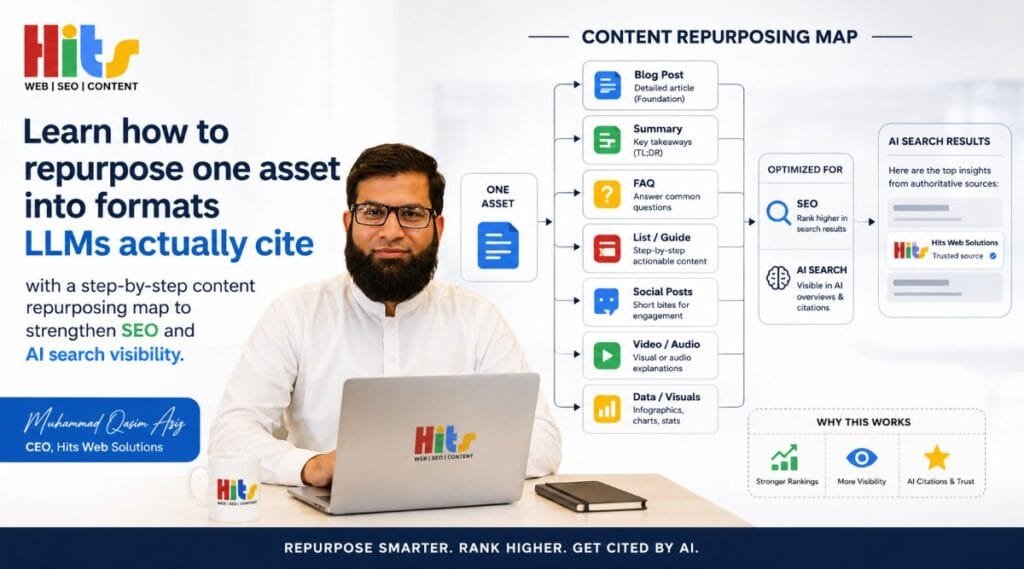
The Strategic Content Repurposing Map
A repurposing map is a planning document built before any spoke content is created. It starts with a single topic, identifies the richest possible primary asset, plans every format and channel in advance, sets a publishing cadence, defines an update cycle, and closes the loop with performance data.
Step 1: Establish Your Core Niche Topic
Anchor the whole map to one clearly scoped question or problem your audience is searching for — and increasingly, asking AI assistants about directly. A tightly defined topic is easier for both search engines and LLMs to associate consistently with your brand across every format you create from it.
Step 2: Develop a Comprehensive Primary Asset
Choose the format able to hold the most original thinking — a comprehensive guide, original research, a detailed case study, or an in-depth webinar. This becomes the hub. Every other format is a spoke: a translation of the hub’s ideas into a different format’s grammar, not a copy-pasted excerpt of it.
Step 3: Fragment Content into Specialized Formats
Map every spoke and its channel before producing anything, and note exactly what each one will extract from the hub — a statistic, a framework, a quote, a single step. This prevents the common failure where five formats repeat the same three points and audiences notice the redundancy.
| Spoke Format | Channel | Key Extract |
|---|---|---|
| LinkedIn carousel | Step-by-step framework | |
| Short-form video | Reels / TikTok | One counterintuitive stat |
| FAQ schema block | Owned blog | Definition + 3 sub-questions |
| Email digest | Newsletter | Summary + exclusive commentary |
Step 4: Orchestrate a Multi-Channel Publishing Cadence
Sequence releases so spokes don’t launch all at once and compete for the same attention — and so the hub has time to get indexed and cited before social commentary references it. A workable default: publish the hub first, add FAQ/schema within 48 hours, roll out social spokes over the following one to two weeks, then release email and sales-enablement formats once early engagement data is in.
Step 5: Implement a Proactive Update Cycle
Set a recurring review date — quarterly works for most competitive topics — to refresh statistics, swap outdated examples, and update the visible “last modified” date. Both traditional search engines and AI crawlers treat a genuine content refresh as new value, not as duplicate content.
Step 6: Monitor Visibility Metrics and Refine
Review which spokes actually drove traffic, citations, or conversions, and which underperformed. Feed those findings back into Step 1 of the next repurposing map — performance data, not channel popularity, should decide which formats earn your time next quarter.
How to Measure and Scale Your AI Visibility
Rankings and click-through rate no longer tell the whole story. AI-era measurement adds citation-specific metrics: how often your content is referenced inside a generated answer, how accurately it’s described, and how much qualified traffic that channel sends back to your site.
| Metric | What It Tracks | Why It Matters |
|---|---|---|
| AI citation share | % of relevant queries where your content is cited | Direct read on generative visibility |
| Citation accuracy | Whether the AI describes your brand/product correctly when citing you | Inaccurate citations can hurt trust even at high visibility |
| AI referral traffic | Sessions arriving from ChatGPT, Perplexity, Gemini, AI Overviews | An emerging channel that often converts well |
| Branded query volume | Searches for your brand name over time | Signals AI-driven discovery turning into direct interest |
| Source diversity score | Whether AI engines cite multiple independent domains, including yours | Shows whether you’re seen as one of several trusted voices |
Set up GA4 segments for AI-platform referral traffic, and periodically run manual prompt audits — ask the AI tools your buyers actually use the questions your content answers, and record whether and how you’re cited. Engines that retrieve live data tend to reflect content changes within weeks; engines relying on static training snapshots lag further behind.
Key Takeaways
- LLMs reward freshness, original statistics, extractable structure, and citations from trusted domains over keyword density.
- One information-dense primary asset can responsibly fuel many channel-specific formats without feeling recycled.
- Plan the repurposing map in a matrix before creating anything, sequence it on a cadence, and refresh it on a schedule.
- Measurement now includes AI citation share and citation accuracy alongside traditional rankings and traffic.
Turn AI Visibility into Your Competitive Advantage
The shift toward Generative Engine Optimization (GEO) and AI-driven search means your brand’s digital footprint must be structured perfectly for both human readers and machine algorithms. Leaving your content strategy trapped in traditional, text-heavy formats means missing out on vital citations across the AI platforms your buyers use every day.
At HITS Web SEO Write, we specialize in bridging the gap between cutting-edge web infrastructure and AI-ready content strategy. With over eight years of deep industry expertise, we help businesses optimize their digital presence for the future of search.
How We Can Help You Scale
- Generative Engine Optimization (GEO): We structure and optimize your existing content assets to ensure your brand is cited, linked, and trusted by LLMs like ChatGPT, Gemini, and Perplexity.
- High-Density Content Atomization: Our team deconstructs your core industry knowledge into specialized, structured data formats—including schema-backed Answer Blocks, data tables, and high-yielding Q&A assets.
- Technical WordPress & Performance Engineering: We build and migrate high-speed, secure web infrastructure optimized for maximum crawl efficiency, core web vitals, and seamless multi-site deployments.
- B2B Industrial & Technical Copywriting: We write deeply researched, authoritative articles, whitepapers, and documentation designed to establish undisputed topical authority in complex, niche B2B sectors.
Ready to dominate the hybrid search landscape?
Don’t let your competitors claim the top AI citations in your industry. Contact HITS Web SEO Write today for a comprehensive AI visibility audit, and let’s build a content repurposing map tailored specifically to your business goals.