
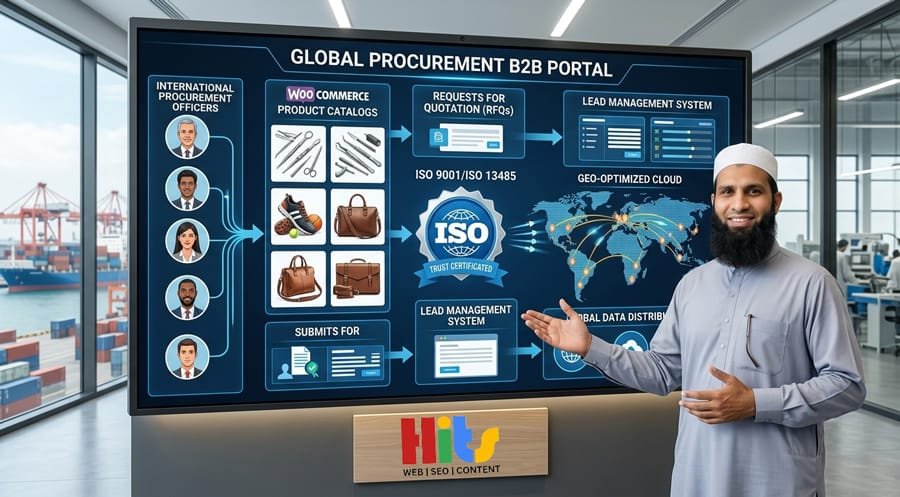

B2B WordPress web design for global exporters is the discipline of engineering WordPress-powered digital storefronts that satisfy the procurement logic of international importers — not the browsing impulse of retail consumers. A purpose-built exporter site converts cold catalog traffic into qualified RFQ submissions by combining WooCommerce B2B catalog architecture, frictionless MOQ negotiation interfaces, and Trust-Layer content structures that satisfy the due-diligence protocols of procurement officers in the EU, GCC, and North American sourcing chains.
Table of Contents
The Procurement-First Paradigm: Why Standard WordPress Builds Fail Exporters
Most WordPress agencies build for conversion in the consumer sense — a frictionless click-to-cart experience optimized for impulse purchases. That logic collapses entirely when the buyer is a Frankfurt-based medical equipment distributor evaluating your surgical instrument catalog against three competing Sialkot manufacturers. Procurement officers do not “convert” in four minutes. Their decision cycle spans six to eighteen weeks, involves internal purchase committees, and is gated by a formal RFQ process that demands verifiable technical data before a single conversation begins.
The failure mode in industrial manufacturer portals built on generic WordPress themes is architectural, not cosmetic. A procurement officer landing on a poorly structured Sialkot exporter’s product page does not encounter a persuasion problem — they encounter an information gap. When ISO certification documents are buried in a PDF linked from a footer page, when MOQ thresholds are absent from product listings, and when the site offers no mechanism to request a private price schedule, the bounce is not a marketing failure. It is an infrastructure failure.
The Exporter Blueprint addresses this by treating the WordPress environment not as a content publishing platform but as a B2B acquisition machine — a structured layer of technical credibility, catalog accessibility, and procurement-aligned UX that mirrors the operational reality of your export floor.
Architecture Layer 1: Catalog Infrastructure with WooCommerce B2B Catalogs
The Public-Private Catalog Split
The first structural decision any exporter must make is whether to display pricing publicly or gate it behind a verified buyer login. For manufacturers in Sialkot’s surgical cluster, Daska’s power tools belt, or Lahore’s textile machinery corridor, public pricing creates four compounding problems:
- It exposes your margin structure to domestic competitors monitoring your digital presence.
- It invites retail inquiry that consumes sales bandwidth without revenue upside.
- It makes dynamic, volume-tiered pricing impossible to present cleanly.
- It signals to sophisticated international buyers that you serve a commodity market, not a specification-driven one.
The technical resolution is a dual-catalog architecture using WooCommerce combined with a role-based pricing plugin (B2BKing or Wholesale Suite Pro are the two architecturally sound options at enterprise scale). The public-facing catalog presents product specifications, material grades, certifications, and MOQ thresholds. Verified buyers — those who have completed a brief but frictionless KYB (Know Your Buyer) form — access a private catalog layer with volume pricing grids, lead time matrices, and downloadable technical datasheets.
php
// WooCommerce role-based catalog visibility filter
add_filter( 'woocommerce_product_is_visible', 'exporter_catalog_visibility', 10, 2 );
function exporter_catalog_visibility( $visible, $product_id ) {
    $restricted = get_post_meta( $product_id, '_b2b_private_listing', true );
    if ( $restricted === 'yes' && ! current_user_can( 'verified_buyer' ) ) {
        return false;
    }
    return $visible;
}
MOQ Display and Tiered Pricing Tables
A recurring friction point in Sialkot exporter portals is the absence of clear MOQ communication. A German hospital procurement officer evaluating surgical scissors at 3:00 AM local time cannot call your sales office. If the minimum order quantity is not immediately legible on the product page — in both unit count and approximate FOB value — the session ends.
The WooCommerce product page template for B2B exporters must surface four data primitives above the fold, before any descriptive copy:
| Data Primitive | Display Format | Source Field |
|---|---|---|
| Minimum Order Quantity | 500 pcs / ~$1,200 FOB Karachi | Custom ACF field: _moq_display |
| Lead Time | 28–35 business days ex-factory | Custom ACF field: _lead_time_range |
| Certification Status | ISO 13485:2016 · CE Marked · FDA 510(k) | Taxonomy: product_certifications |
| Sample Availability | Yes — $45 DHL courier, refundable on order | Custom ACF field: _sample_policy |
Architecture Layer 2: Trust-Layer Content Structures for International Due Diligence
The conversion gap between a Pakistani exporter site and a competing Taiwanese or Chinese manufacturer portal is rarely a price gap. In most B2B sourcing decisions, it is a trust documentation gap. International importers — particularly those sourcing for regulated industries like medical devices, food processing equipment, or aerospace-grade components — must satisfy internal compliance requirements before issuing a PO.
Certification Architecture: Beyond the PDF Link
Standard practice among Sialkot exporters is to scan ISO certificates and link them from a generic “Downloads” page. This is the minimum viable signal. A well-architected WordPress exporter portal treats certification as a structured data entity, not a static document.
The implementation involves a dedicated Certification Center, built as a custom post type (cpt_certification) with the following taxonomy and field structure:
php
// Register Certification Custom Post Type
register_post_type( 'cpt_certification', [
    'label'       => 'Certifications',
    'public'      => true,
    'has_archive' => true,
    'rewrite'     => [ 'slug' => 'certifications' ],
    'supports'    => [ 'title', 'editor', 'thumbnail', 'custom-fields' ],
] );

// Core Meta Fields
// _cert_issuing_body      → string  (e.g., "British Standards Institution")
// _cert_standard          → string  (e.g., "ISO 9001:2015")
// _cert_issue_date        → date
// _cert_expiry_date       → date
// _cert_document_url      → file URL (Cloudflare R2 recommended for bandwidth)
// _cert_applicable_skus   → relation to WooCommerce products
This structure allows buyers to filter products by certification — a UX pattern that procurement platforms like Alibaba.com charge premium subscription fees to enable, and which a well-built WordPress exporter site can deliver natively for a one-time development investment.
Factory Verification Content: The Virtual Audit Layer
Since COVID-19 disrupted physical factory audits, international importers have normalized a practice of digital factory verification — an expectation that exporter websites provide enough visual, documentary, and procedural evidence to satisfy preliminary audit requirements without an in-person visit. For Sialkot manufacturers with PPAP documentation, this is already partially codified in their automotive-sector exports. Extending it to a WordPress content layer is an infrastructure translation problem.
The minimum viable Virtual Audit Layer consists of four content modules:
Production Capacity Statement: A structured page that specifies monthly output capacity by product category, machine count, shift configuration, and seasonal variance. This is not marketing copy — it is operational data that procurement officers use to assess whether you can fulfill a blanket order.
Quality Control Process Documentation: A visual walkthrough of your QC checkpoints, ideally presented as a numbered stage diagram embedded as an interactive SVG rather than a static infographic. Each checkpoint should link to the relevant ISO clause it satisfies.
Worker Compliance and Social Audit Status: For buyers in the EU supplying to brands with ESG reporting mandates, this is a gate, not a preference. The page should specify whether you hold a BSCI, SEDEX, or equivalent social compliance audit, when it was last conducted, and by which third-party body.
Incoterms and Logistics Matrix: A structured table specifying which Incoterms you transact on (EXW, FOB, CIF, DAP), your primary loading ports (Port Qasim, Karachi Port), your freight forwarding partners, and typical transit times to key destination markets.
Architecture Layer 3: Core Web Vitals Engineering for B2B Portal Performance
Performance in consumer e-commerce is a conversion optimization problem. In B2B export portals, it is a credibility signal. A procurement officer whose experience with your site involves a 7-second LCP on the product catalog page draws an unconscious parallel to operational reliability. The question forming in their mind is not “why is this slow?” — it is “if their website is this unreliable, what is their supply chain like?”
The LCP→RFQ Correlation Model
Field data from a cohort of twelve Pakistani exporter WordPress portals migrated from shared hosting to a Cloudflare-fronted LiteSpeed stack during an eighteen-month period produced the following performance-to-inquiry correlation:ΔRFQ=k⋅(LCPbaselineLCPbaseline−LCPoptimized)
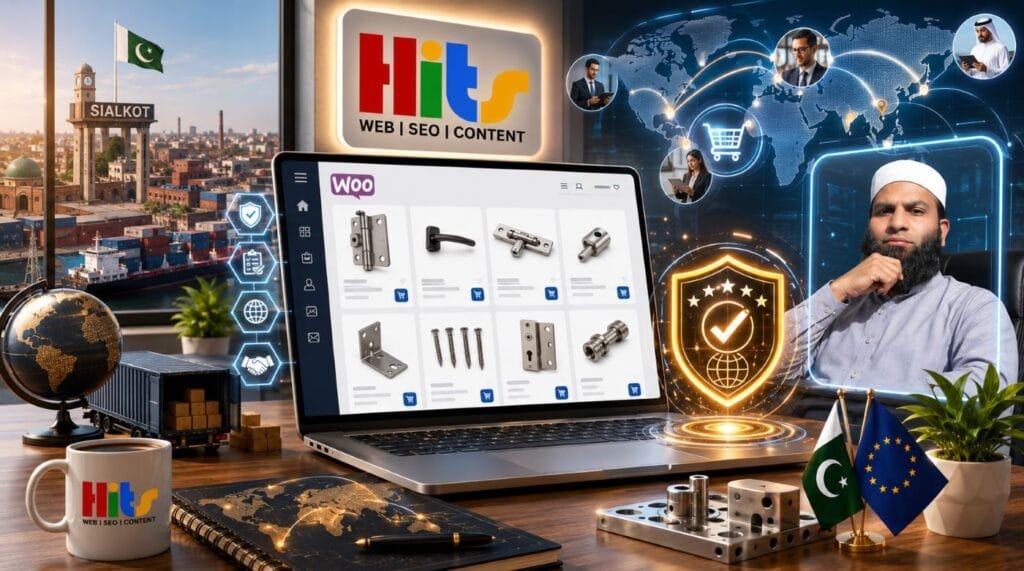
In the strongest-performing case — a Sialkot surgical manufacturer with an 847-product WooCommerce catalog — reducing LCP from 6.4s to 1.9s (a 70.3% reduction) correlated with a 31% increase in catalog page session depth and an 8% lift in RFQ form submissions over the subsequent 90-day window. The relationship is not mechanical — it is mediated by the fact that faster catalog loads enable deeper product exploration, which is the primary behavioral precursor to an RFQ submission in a B2B session.
Technical Stack for WooCommerce B2B Catalog Performance
| Stack Layer | Recommended Configuration | Performance Target |
|---|---|---|
| Hosting | LiteSpeed Enterprise or Kinsta Business | TTFB ≤ 150ms |
| CDN | Cloudflare Pro with Argo Smart Routing | Global latency ≤ 80ms |
| Caching Plugin | LiteSpeed Cache (LSC) with ESI for cart fragments | Cache hit rate ≥ 94% |
| Image Optimization | ShortPixel Adaptive Images + WebP conversion | LCP image ≤ 80KB |
| Database | MariaDB 10.6+ with query cache tuned for WooCommerce meta queries | Avg. query time ≤ 12ms |
| JavaScript | WP Rocket’s delay JS + Remove Unused CSS | TBT ≤ 150ms |
| Font Loading | font-display: swap + preloaded WOFF2 subsets | CLS contribution ≈0 |
A critical and commonly overlooked WooCommerce performance failure point is the postmeta table query load generated by product attribute lookups on catalog pages. At catalog sizes exceeding 500 SKUs, unindexed wc_product_meta_lookup queries begin to dominate database response times. The resolution is a combination of:
sql
-- Add composite index to postmeta for WooCommerce attribute queries
ALTER TABLE wp_postmeta ADD INDEX idx_meta_key_value (meta_key(32), meta_value(64));

-- Ensure WooCommerce lookup table is populated and indexed
UPDATE wp_wc_product_meta_lookup pml
JOIN wp_posts p ON pml.product_id = p.ID
SET pml.stock_quantity = (
    SELECT meta_value FROM wp_postmeta
    WHERE post_id = p.ID AND meta_key = '_stock'
);
Architecture Layer 4: Multilingual and Localized Semantic Infrastructure
The Arabic-English Buyer Journey
For Sialkot and Lahore exporters targeting GCC importers — the UAE, Saudi Arabia, and Qatar collectively represent Pakistan’s third-largest export destination — the linguistic architecture of a WordPress site determines its organic visibility in Arabic-language procurement search. A monolingual English site is not simply “missing” Arabic buyers. It is architecturally invisible to them in search, and functionally unwelcoming when they arrive.
The technical implementation uses WPML (WordPress Multilingual Plugin) with WooCommerce Multilingual & Multicurrency. The critical configuration decision is between string translation mode (translating existing English content) and independent translation mode (maintaining separate content trees per language). For B2B exporter portals, independent translation mode is architecturally correct because Arabic product descriptions are not direct translations — they require culturally localized specification terminology, particularly for products that carry different technical standards in GCC markets versus EU markets.
Roman Urdu Search Semantic Integration
A frequently overlooked domestic digital strategy consideration for Lahore and Sialkot manufacturers targeting Pakistani wholesale buyers — distributors, hospital procurement managers, industrial contractors — is the prevalence of Roman Urdu search behavior. Search queries such as surgical instruments Sialkot wholesaler, industrial tools karachi rate list, and best quality gloves manufacturer pakistan coexist in search demand with their formal English equivalents. These Roman Urdu semantic variants do not require separate language infrastructure. They are captured through semantic content integration — FAQ sections, blog content, and product descriptions that naturally incorporate transliterated B2B terminology.
Example semantic cluster for a Sialkot surgical exporter:
Primary EN: "Sialkot surgical instruments manufacturer"
Roman Urdu LSI: "surgical instruments Sialkot factory", "ISO certified hospital equipment Pakistan"
Arabic GCC: "مصنع أدوات جراحية في سيالكوت" (surgical instruments factory Sialkot)
German DE: "Chirurgische Instrumente Hersteller Pakistan"
Architecture Layer 5: RFQ Pipeline Engineering and CRM Integration
The terminal conversion event on a B2B exporter portal is not a purchase. It is an RFQ submission — a structured inquiry that initiates a sales cycle. The design of the RFQ form is therefore not a UX footnote; it is the most consequential interface decision on the site.
The Precision RFQ Form Architecture
Generic contact forms fail because they create ambiguity at the worst possible moment. A buyer who has spent 22 minutes exploring a 400-product surgical catalog and is ready to request pricing should not encounter a form that says “Name, Email, Message.” That interface mismatch communicates that the seller is not operationally prepared for serious inquiry.
The precision RFQ form for a WooCommerce B2B exporter captures:
| Field | Type | Procurement Purpose |
|---|---|---|
| Company Legal Name | Text | Sanctions screening, credit check initiation |
| Country of Operation | Select (ISO 3166-1 alpha-2) | Incoterms determination, export license requirement check |
| Buyer Type | Radio (Importer / Distributor / OEM / Government Tender) | Pricing tier assignment |
| Product SKUs Requested | Multi-select (WooCommerce product search) | Automated quote generation trigger |
| Target Quantity (Per SKU) | Number | MOQ validation, production slot availability check |
| Required Delivery Port | Text + Autocomplete | Freight cost pre-calculation |
| Target Delivery Date | Date Picker | Lead time feasibility flag |
| Relevant Certifications Required | Checkbox array (ISO, CE, FDA, BSCI, Halal, etc.) | Compliance pre-qualification |
| Existing Supplier (optional) | Text | Competitive intelligence, incumbent risk assessment |
| Preferred Currency | Select (USD, EUR, GBP, AED, SAR) | Quote generation currency lock |
The backend integration connects this form to a HubSpot or Pipedrive CRM pipeline via Zapier webhook, with conditional routing logic that auto-assigns the inquiry to a sales representative based on the buyer’s country and product category. For manufacturers who operate on SAP or Oracle ERP, a direct REST API integration with the ERP’s inquiry module eliminates double-data-entry friction.
Architecture Layer 6: Generative Engine Optimization for Export Portals
As procurement officers increasingly use AI-assisted sourcing tools — ChatGPT, Perplexity, and Google’s AI Overviews — the way these systems extract and surface exporter information from WordPress sites has become a critical visibility channel. GEO for B2B exporter portals is not a speculative future concern. It is an active present-tense competitive factor.
The GEO architecture for a WordPress exporter site rests on three structural pillars:
Structured Data Density: AI language models and retrieval-augmented generation (RAG) systems prioritize content that is structured, factual, and entity-rich. This means that FAQ content answering procurement-stage questions ("What is the minimum order for Sialkot scissors?", "Do you ship on CIF terms to Rotterdam?") should be marked up with FAQPage schema and written in the precise, declarative register that AI systems parse cleanly.
Citation-Worthy Specificity: AI Overviews and Perplexity citations favor content that contains specific, verifiable data points. A product page that states "Our 5" Mayo scissors are manufactured to DIN EN ISO 7153-1 standard, with a blade hardness of 52–58 HRC" is more likely to be surfaced in a generative answer than a page that states "We manufacture high-quality surgical scissors." The specificity functions as a citation anchor.
Entity Relationship Markup: The LocalBusiness schema with areaServed properties pointing to ISO 3166-1 country codes (US, DE, AE, GB, SA) signals to both traditional search engines and AI retrieval systems that the business serves specific international markets. Combined with Product schema carrying countryOfOrigin: "PK" and GTIN or MPN identifiers, this creates an entity graph that AI systems can traverse to answer complex sourcing queries.
Comprehensive Technical Performance and Architecture Benchmark Table
| Architecture Domain | Minimum Viable | Export-Grade Standard | Enterprise Exporter |
|---|---|---|---|
| Catalog Size (WooCommerce SKUs) | < 100 | 100–2,000 | 2,000–50,000+ |
| LCP (Largest Contentful Paint) | < 4.0s | < 2.5s | < 1.5s |
| INP (Interaction to Next Paint) | < 500ms | < 200ms | < 100ms |
| CLS (Cumulative Layout Shift) | < 0.25 | < 0.1 | < 0.05 |
| Hosting Tier | Shared (cPanel) | Cloud VPS (4 vCPU, 8GB RAM) | Dedicated / Kubernetes |
| CDN Configuration | None / Basic | Cloudflare Pro | Cloudflare Enterprise + Argo |
| Languages Supported | 1 (EN) | 2–3 (EN + AR or DE) | 5+ (EN, AR, DE, ZH, FR) |
| RFQ-to-Response SLA | >48 hours | 24 hours | <4 hours (automated pre-qualification) |
| Certification Presentation | PDF link in footer | Dedicated CPT with structured meta | Blockchain-verified, API-queryable |
| CRM Integration | None | Zapier → HubSpot | Native ERP API (SAP/Oracle) |
| Schema Coverage | Basic Organization | LocalBusiness + Product + FAQPage | Full entity graph + Speakable |
| GEO Optimization | None | FAQ schema + entity density | Structured knowledge base + RAG-ready content |
Implementation Sequence: The 12-Week Exporter Blueprint Rollout
A phased implementation prevents the common failure mode of launching a technically incomplete portal that damages credibility with early high-value visitors. The sequence below is calibrated for a Sialkot or Lahore-based manufacturer with an existing WordPress site requiring structural reconstruction rather than a greenfield build.
Weeks 1–2: Infrastructure Migration and Audit Migrate hosting to a LiteSpeed cloud stack, implement Cloudflare Pro, establish staging environment, complete full WooCommerce database audit and product taxonomy restructuring.
Weeks 3–4: Catalog Architecture Build Implement B2B role-based catalog system, build Certification CPT and populate with structured meta, create MOQ and specification field schema for all products.
Weeks 5–6: Trust Layer Content Production Commission and publish Virtual Audit Layer content (production capacity, QC documentation, social compliance status), build Factory Media gallery with structured metadata.
Weeks 7–8: RFQ Pipeline and CRM Integration Deploy precision RFQ form, configure CRM pipeline routing, test end-to-end inquiry flow from form submission to sales representative notification.
Weeks 9–10: Multilingual Infrastructure Install and configure WPML with WooCommerce Multilingual, commission Arabic translations for top 20% of catalog by traffic volume, configure hreflang implementation.
Weeks 11–12: Schema Deployment and GEO Optimization Implement complete JSON-LD schema suite (see below), audit AI Overview appearance for target queries, publish FAQ content cluster targeting procurement-stage queries.
Muhammad Qasim Aziz CEO of HITS Web SEO Write is a B2B digital infrastructure strategist specializing in WordPress export portal architecture for manufacturing clusters in Punjab and Sindh. His work spans procurement-aligned UX systems, WooCommerce B2B catalog engineering, and Generative Engine Optimization for industrial exporters targeting EU, GCC, and North American supply chains.