
Table of Contents
🛑 The Hard Truth: Is Your Organic Traffic Disappearing?
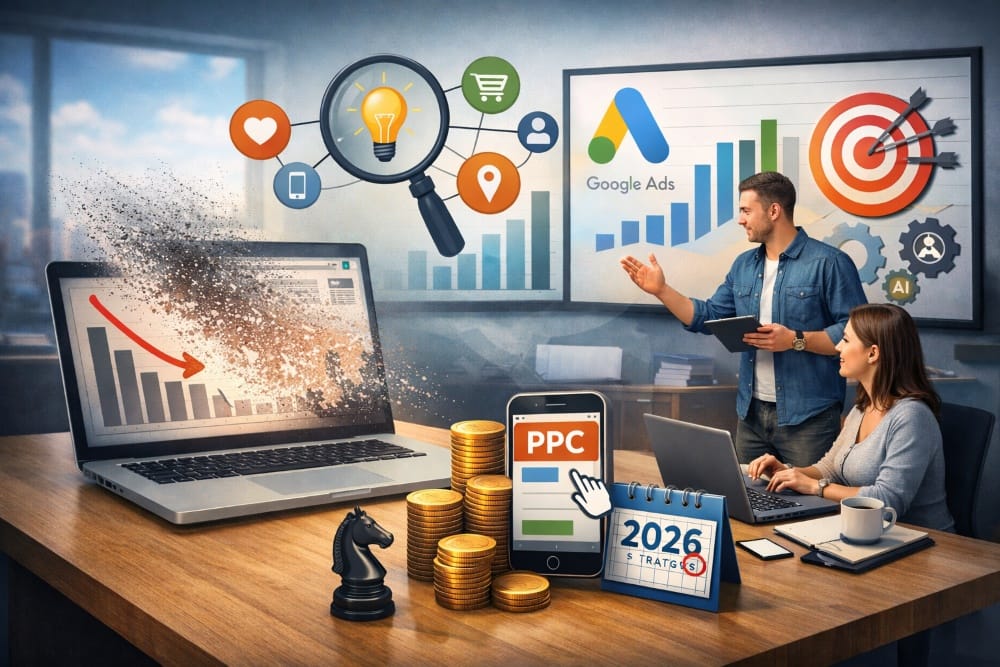
Before we dive into the “How,” we must address the “Why.” Many businesses in 2026 are noticing a sharp decline in organic click-through rates, even while maintaining their #1 rankings.
This isn’t a glitch; it’s a structural shift. With AI Overviews (AIO) and Search Generative Experience (SGE) occupying the first two “scrolls” of a mobile screen, the “Blue Link” has been pushed into the basement. In this “Zero-Click” reality, Google Ads is no longer just a supplement to SEO—it is the primary gatekeeper of immediate visibility. But to pass through that gate, you have to speak the language of the machine: Intent.
🧠 The Mechanics Under the Hood: From “Strings” to “Signals.”
In the “Old Model,” Google matched a query like “best web designer in Karachi” to a keyword in your account. In 2026, the query is just one of thousands of data points.
The Shift: Precision vs. Prediction
| Feature | The Keyword Era (Old) | The Intent Era (2026) |
| Logic | Text Matching | Behavioral Prediction |
| Bidding | Static/Rule-based | Real-time Auction-time Bidding |
| Targeting | What they typed | Who they are + What they’ll do next |
| Ad Delivery | Based on “Match Types” | Based on “Conversion Probability” |
Google’s AI now calculates a Conversion Probability Score for every single user in real-time. It looks at their browsing history, the time of day, their device’s “Interaction to Next Paint” (INP) history, and even the semantic meaning of your creative assets.
Key Takeaway: Google is no longer bidding on the query; it is bidding on the predicted outcome.
🏗️ The New Operational Blueprint: Building for Intent
If keywords are secondary, what are the primary levers of success? To survive the year, your account structure must prioritize Training Data over Text Strings.
1. The Performance Max & Demand Gen Synergy
In 2026, “Performance Max” (PMax) is no longer a choice; it is the engine. However, the secret sauce is feeding it the right Audience Signals.
- First-Party Data: Uploading your CRM data isn’t optional. It provides the “Seed Audience” that the AI uses to find “Lookalikes” with similar purchase intent.
- Signal Layering: Layering “In-Market” and “Life Events” signals allows the AI to narrow its focus, preventing it from wasting your budget on “window shoppers.”
2. Landing Page Evolution: The “Response” to Intent
Since Google’s AI now “reads” your website to determine ad eligibility, your landing page is no longer just a destination—it’s a Targeting Signal.
- Semantic Depth: Your page content must match the depth of the user’s intent. If they are in the “Research” phase, the page should offer data. If they are in the “Buy” phase, it should offer a frictionless checkout.
- Technical Health: AI algorithms prioritize pages with a perfect 100/100 Core Web Vitals score. A slow-loading page in 2026 is a signal to Google that the “Intent Match” is low.
3. Asset Volume as Training Data
Think of your Headlines, Descriptions, Images, and Videos as “fuel” for the AI.
- Creative Diversity: If you only provide text, you are limiting your eligibility. You need high-quality video and lifestyle imagery.
- The AI Scan: Google’s Vision AI scans your images. If you are selling “Luxury Web Design” but use cheap stock photos, the AI will predict lower conversion value and lower your bid priority.
📉 The Gaps: Navigating the “Black Box” Challenges
While intent-based advertising is more efficient, it comes with a transparency cost that every CMO should be aware of.
1. The Transparency Gap (Reporting Segmentation)
We have lost the ability to see exactly which “search term” led to which “conversion” in many automated campaign types. In 2026, we manage by Attribution Modeling and Incrementality Tests rather than granular search term reports.
2. The Budget Barrier: The “Minimum Effective Dose.”
AI needs data to learn. If your budget is too low (e.g., trying to run a national campaign on $10/day), the machine never finishes its “Learning Phase.”
- The Rule of 30: You generally need a minimum of 30–50 conversions per month per campaign for the “Intent Engine” to calibrate correctly.
3. Funnel Position Matters
Intent isn’t binary. There is a difference between “Problem Aware” intent and “Brand Ready” intent. A common mistake in 2026 is treating all intent the same. You must segment your campaigns to catch users at different stages of the funnel.
Bridging the Gap with HITS Web SEO Write
Navigating the transition from “Keyword PPC” to “Intent-First Marketing” requires a holistic approach that combines technology, design, and content. At HITS Web SEO Write, we specialize in the three pillars required to feed the 2026 Google Ads engine:
🌐 High-Performance Web Design
Google’s AI evaluates your site’s architecture to determine your ad’s quality score. We build lightning-fast, mobile-first websites in Pakistan that don’t just look stunning—they act as high-octane signals that tell Google, “This brand is the best answer for the user.”
🔍 Next-Gen SEO Strategies
As organic traffic becomes harder to capture, our SEO services focus on Entity-Based Optimization. We ensure your brand is recognized as an authority in your niche, which inherently improves your Google Ads “Trust Score” and reduces your CPC (Cost Per Click).
✍️ Content That Converses with AI
Our content writing isn’t just for humans; it’s for the Large Language Models (LLMs) that power search. We create “Information-Gain” content and rich ad assets that provide the necessary training data for Google’s predictive models to find your highest-value customers.
🚀 Your Strategy Must Be Dynamic
The “Set it and Forget it” era of Google Ads is dead. In 2026, success belongs to those who view their ad account as a living ecosystem of signals. You are no longer an “Ad Manager”; you are an AI Trainer.
❓ Frequently Asked Questions
Q1: If keywords are no longer the “boss,” should I stop doing keyword research entirely?
Not at all. In 2026, keywords have transitioned from “strict instructions” to “contextual hints.” You still need them to guide the AI toward the right neighborhood, but you should no longer spend hours obsessing over exact-match variants. Focus instead on Semantic Themes—broad topics that define your expertise—and let Google’s intent engine find the specific queries that lead to conversions.
Q2: My Google Ads budget is small. Can I still compete with the “Intent Engine”?
It’s harder, but possible. The AI needs a “Minimum Effective Dose” of data to learn. If your budget is too thin, the machine stays in the “Learning Phase” indefinitely. For smaller Pakistani SMBs, we recommend Hyper-Local Targeting. Instead of targeting all of Pakistan with a small budget, dominate a specific area (like DHA Lahore or Clifton Karachi). This concentrates your data signals, allowing the AI to calibrate faster on a smaller spend.
Q3: Why can’t I see exactly which search terms my customers are typing anymore?
Google has moved toward a “Privacy-First” reporting model. While it can be frustrating to see your data hidden in a “Black Box,” the focus has shifted from what they typed to how they behaved. In 2026, the metric that matters isn’t the Search Term Report; it’s the Conversion Value vs. Spend. If the AI is hitting your ROI targets, the specific string of text the user typed becomes a secondary technical detail.
Q4: Will my high-quality Web Design actually lower my Google Ads costs?
Absolutely. In 2026, Google’s AI performs a “Deep Crawl” of your landing page before every auction. If your site—designed by a team like HITS Web SEO Write—features lightning-fast load times (SSR/SSG), high technical purity, and clear semantic headers, your Quality Score increases. This allows you to win higher ad positions while paying less than competitors with slow, cluttered websites.
Q5: Is it better to run Google Ads or focus on SEO in this AI-heavy environment?
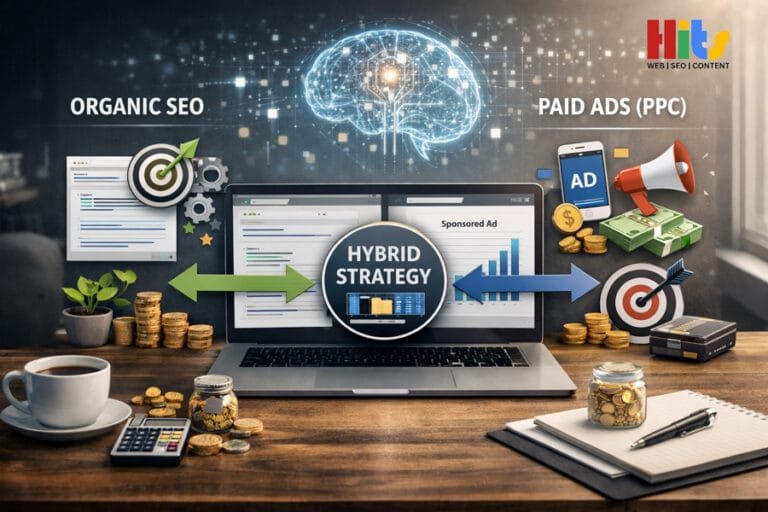
The most successful brands in 2026 use a Hybrid Strategy. SEO builds your “Entity Authority” and trains the AI to trust your brand, while Google Ads captures the high-intent traffic that AI Overviews might otherwise “hide.” Think of SEO as your long-term reputation and Google Ads as your high-speed sales closer. You need the credibility of the former to lower the costs of the latter.
Would you like a complimentary “Intent Audit” of your current Google Ads account to see where your budget is leaking into low-intent traffic?